Longtime biographer Arnold Rampersad said his new volume, The Selected Letters of Langston Hughes, reveals a “deeper, more complicated” man than the public has ever known. Sitting comfortably on stage at the Schomburg Center for Research and Black Culture, co-editors Rampersad and David Roessel, professor at Richard Stockton College in New Jersey, spoke on the complexities of the man called the voice of “Negro America.”
Rampersad, who has twice beenhonored with an Anisfield-Wolf award for his work on Langston Hughes, said that the writer’s calling came to him early in life. “He was going to take on one of the most extraordinary challenges that anyone could take on—that is to be an African-American in the 1920s and decide, ‘I want to be a writer. And oh, by the way, I want to write about African-American culture,'” Rampersad said. “Not the number one topic in literature by any stretch of the imagination.”
Roessel praises Hughes’ prescience: “From this early age, he knew that people would be interested in his letters. They understood that they were doing something that had not been done before and the world was going to take notice. And it’s nice that the world had.”
Watch their conversation in the video below.
An introspective, respectful and sold-out City Club audience gathered to consider the long march to equality for transgender people in Northeast Ohio. Activist Stacey Parsons spoke directly to the elected officials in the room: “Without your support, nothing can change. Your being here says so much to the community.”
Darius Stubbs, a Cleveland teaching artist, added that “public policy helps change the city and if changes are made there, then people have to evaluate where they stand personally.”
The session opened with Dr. Kevin Ng, who directs the MetroHealth’s PRIDE Clinic, where he estimates two-thirds of his patients are transgender. He began with a quick lesson: Biological sex is the sex assigned at birth, whereas gender identity is how people see themselves when they close their eyes. On the flip side, gender expression is how people choose to present themselves the outside world. A person is transgender when their biological sex and gender identity don’t coincide.
Parsons was congenial and straightforward: “Ask questions if you have a question. Kids learn from how you treat us.”
Whatever the stogy Midwest stereotype, Cleveland is a leader in anti-discrimination measures for the LGBT community, said Susan J. Becker, a Cleveland State University law professor. But there is still room for growth. She mentioned the proposed city ordinance that would require public spaces such bathrooms and locker rooms to be available on a nondiscriminatory basis. This law would allow transgender individuals to use the restroom they feel most comfortable in.
Actually passing such measures requires much community education, Ng said, noting that it could begin in hospitals and clinics. Most medical schools offer only five hours of instruction regarding LGBT care, he said. “And the ‘T’ is usually the smallest part.”
Patients who are transgender often meet hostility instead of “care.” Parsons said, “Physicians have told me they don’t want to deal with me and will treat me like a man” as the room went silent. “If that’s not the most dehumanizing thing…” And Stubbs said his doctor sent a letter suggesting he seek a different care provider. Becker said there is little legal recourse: in only one third of states is discrimination against transgender people illegal.
Moderator Connie Schultz asked how journalists can produce more accurate reporting of transgender issues.
“It’s horrifying when [journalists] misgender someone,” Parsons responded. “They’ll write, ‘an oddly dressed man, wearing women’s clothing.’ That’s obviously a transgender individual. It’s a blatant disrespect to the individual. All it does is bring negative attention to the transgender community.”
When Stubbs was asked if he faced any particular challenges transitioning as a person of color, his response was sobering.
“I’ve become very aware of how differently black men are treated in society,” he said carefully. “I’m very aware of the palpable fear that comes from people, when they are trying to engage a man of color. There’s an immediate feeling of ‘you are a predator’ that comes off when you talk to people. It’s something I’m still having to deal with.”
by Rachel Burstein
Our experience of a book can be changed—and enriched—when we read it alongside people who are different from us. That’s the verdict from participants at a recent Books@Work program in Cleveland. The group read The Warmth of Other Suns from Pulitzer Prize-winning journalist Isabel Wilkerson. Her meticulously researched and beautifully told history of the Great Migration won a 2011 Anisfield-Wolf Book Award.
Books@Work is a non-profit organization that brings professor-led literature seminars into the workplace and to a variety of community settings.
Few participants in a recent seminar were prepared for how profoundly reading and discussing Isabel Wilkerson’s book would hit them. Many recognized elements of their own family history in the book, causing them to reevaluate the role of individuals—especially people of color—in making history. Led by Michelle Rankins, an adjunct professor at Cleveland State University, readers explored thinking of themselves as part of a continuing narrative, and potential agents of change. As Professor Rankins put it, “There are so many universal themes in the text.”
One woman said that reading The Warmth of Other Suns encouraged her to investigate her own family history, tracing her grandmother’s journey from the Deep South to Cleveland during the Great Migration. She said she wished “that I had talked to her more about her upbringing and what made her come from the South up to the North. You know people left and came up, but you didn’t realize the reasons why and how they came up here with no idea what they were getting themselves into. That brought me to thinking I should maybe go find some more of my relatives we don’t really communicate with and just see if we can get more family history going.”
In many ways, Wilkerson’s book is a guide to Cleveland and other rust-belt cities whose history and culture were shaped by the Great Migration. And for many African-Americans in Cleveland—one or two generations removed from Southern roots—Wilkerson’s powerful narratives echo their own stories. One man said he was unaware of the profound historical and present-day discrimination that African-Americans encountered in the North, adding that reading the book with colleagues spurred him to inquire more about the racism that others in the group had faced. “I said [to my colleague], ‘I hate to admit it, but I had never heard of Jim Crow until I read this book,’ the participant said. “You know, and she looked at me and says, ‘Did you grow up under a rock?’ I said, ‘Yeah. I did.’ So we got into a discussion.”
These conversations are critical, in Cleveland and the larger world.
The Warmth of Other Suns is a powerful tool, asking readers to reflect on their own place among its narrative. These discussions can be difficult and complex: calling forth acknowledgment of complicity and privilege for some readers, and admission of failure to engage the past on the part of others. But there is also a chance—through literature—for the ordinary human being to shape and influence the story, and the world in which we find ourselves today.
That is why professors in the Books@Work seminar play such an important role in directing the conversation and fostering honest dialogue. It is the alchemy of the professor, the text and—crucially—the group members themselves, that allowed participants in the Books@Work seminar to take away so much from The Warmth of Other Suns.
Books@Work offers programs in a variety of sectors, states, and community settings. If you are interested in learning more, please contact Books@work through the website.
Rachel Burstein, PhD is a labor historian and Academic Director at Books@Work. Follow her on Twitter.
In a popular U.S. high school history textbook, The Americans, there is only one sentence—in passive voice—on housing discrimination among more than 1200 pages of text: “African-Americans found themselves forced into segregated neighborhoods.”
So noted researcher Richard Rothstein, who cited this fact as an exemplar of American “collective amnesia” when it comes to how we discuss segregation. Such disingenuousness, he told the City Club of Cleveland, keeps our nation from righting past wrongs.
With minimal use of his notes, Rothstein drew a precise and powerful link between the current achievement gap among the races and our country’s legacy of inequality. “We do not have de facto segregation in this country,” he maintained, to murmurs of agreement in the audience. “We have explicit racial apartheid and we have forgotten the history of how this came about.”
Rothstein devoted the bulk of his City Club presentation to revisiting this history, beginning with the public policies in the 1940s that restricted black families to crowded public housing units and prevented black veterans from taking full advantage of the housing benefits in the G.I. Bill after World War II. Those national policy decisions stripped black families of the opportunity to generate the generational wealth enjoyed by whites.
Levittown, a Long Island, N.Y. suburb that boomed in the 1940s, makes a poignant example. Rothstein estimates that white homeowners who purchased their residences in the 1950s saw a 200% increase in equity in the following decades, which often sent children to college or enhanced businesses.
Simply outlawing discrimination doesn’t remedy years of injury, Rothstein argued, particularly as the effect of housing inequity still plagues American schools today: “We have a constitutional obligation to undo this history. It was not an accident. It was created under public policy. We have an obligation to reverse it.”
Rothstein also recommends reforms in the labor market, including the end of unpredictable scheduling for many low-wage occupations, overwhelmingly held by parents of color. Fifty percent of all black hourly workers receive their weekly schedules less than one week in advance, he noted, making it difficult to find consistent childcare or set mealtimes. “Giving parents stable work lives would do more to close the achievement gap than any education reform we can talk about.”
Questions from the audience were measured, including two from local high school students. Anthony Price from Shaw High School asked if Rothstein had suggestions for young people in eradicating inequality, in light of a recent City Club forum that placed youth at the center of the conversation, which he moderated. Rothstein circled back to his textbook example. “Educate yourselves about this history and insist that it become part of the curriculum,” he said to applause.
Will Congress or the Supreme Court address modern segregation? Rothstein insisted on the long view: “It’s going to take a long process of reeducating the American public. The Supreme Court is not going to go where we fear to go.”
Bryan Stevenson—campaigner against mass incarceration and author of a new report linking the ubiquity of lynching in the American South to violence against black men today—will make his case in Cleveland.
“We have a system of justice in this country that treats you much better if you’re rich and guilty than if you’re poor and innocent,” Stevenson told the audience at his TED Talk. “Wealth, not culpability, shapes outcomes.”
That 24-minute address, which received two standing ovations and more than two million views, represents the crux of Stevenson’s life work. As founder of the Equal Justice Initiative in Montgomery, Alabama, the attorney and New York University law professor devotes his life to challenging a culture of mass incarceration and advocating for the rights of juveniles in the justice system. In 2012, he won a case before the U.S. Supreme Court establishing the unconstitutionality of sentencing minors to life in prison for crimes that aren’t homicide.
Stevenson, 55, will present his latest research and insights in a free, community forum called “Let’s Talk About Injustice”March 19 at Cleveland State University. The Cleveland chapter of Facing History and Ourselves is hosting; the Anisfield-Wolf Book Awards is a community partner.
In “Just Mercy,” a memoir published last October, Stephenson focuses on his professional life battling judges and prosecutors on behalf of railroaded defendants, often poor people of color. He builds the book around the case of Walter McMillian, an Alabama man housed on death row for the murder of a young white woman even before the trial—despite mounds of evidence of innocence. Shortly after winning McMillian’s appeal in 1995, Stevenson won a MacArthur “genius” grant. He and the staff at EJI used the MacArthur money at EJI to build legal challenges that have rescued more than 100 defendants from death row.
Like Michelle Alexander, author of “The New Jim Crow,” Stevenson is a systemic thinker. “I don’t believe that the opposite of poverty is wealth,” he told Jon Stewart on the Daily Show during his October appearance. “I believe that in America, the opposite of poverty is justice.”
Tickets to the March 19 event are free but registration is required..
People of color make up close to 40 percent of the current U.S. population, so what would you do about the desert in children’s literature where fewer than one in ten books feature multi-cultural characters or themes? That question framed the American Library Association’s “Day of Diversity” last month as participants dug into a problem whose contours have barely changed in half a century.
Organizers challenged librarians, publishers, writers, editors, booksellers and educators at the Chicago meeting to come up with ways to increase diversity on the typical American child’s bookshelf. Children’s author Elizabeth Bluemle plucked seven audience suggestions for her Publishers Weekly blog, each capable of yielding immediate, tangible results:
1) Adopt a classroom.
2) Buy a book by an author of color featuring a main protagonist of color.
August Wilson, winner of an Anisfield-Wolf Lifetime Achievement award in 2005, used to begin writing his plays on napkins to elude the fear of the blank page.
And the Rev. Dr. Martin Luther King—also an Anisfield-Wolf recipient—was so unsure of himself in front of a group that he received a C+ in public speaking at seminary, only to drift down to a C in the second semester. When art historian Sarah Lewis saw that transcript, it served as a revelation.
“When I saw this at Sotheby’s, I knew I needed to write this book,” Lewis told Seth Meyers last year. “Because if we are not telling the full arc of people’s lives and stories, then we deprive ourselves of the roadmaps we need.”
Her book is “The Rise: Creativity, the Gift of Failure and the Search for Mastery.” Published in 2014, it marked Lewis as a promising public intellectual, profiled in Vogue Magazine under the headline “Brainiac Rising.”
Lewis, 35, grew up in Manhattan and took degrees at Harvard, Yale and Oxford universities. She made her first visit to Cleveland as a Town Hall speaker for Case Western Reserve University. “This is the first time I’ve been asked to speak on innovation in the context of diversity,” she said, a smile ever-present as she wove parts of her Ted Talk (1.3 million views) into this new terrain.
Lewis started in Cleveland with the story of Charles Black, who at age 16 had his first encounter with genius, accidentally hearing Louis Armstrong play his trumpet in 1931 at an Austin, Texas hotel. The boy was thunderstruck that this genius “was housed in the body of a man whom Black’s childhood world had denigrated.” The force of this incongruity set young Charles on a path that led to the law, and to his joining the team that successfully argued Brown vs. Board of Education in 1954.
Lewis, as someone who thinks deeply about art, is fascinated with the connection between social justice and vision. She points out in “The Rise” that a very-detailed schematic of a slave ship, circulated in London in 1789, lent a crucial blow to slave trade under the British flag.
Her next book, due in 2016 from Harvard University Press, will focus on social justice and Frederick Douglass. He makes several appearances in “The Rise.” Intriguingly, the great abolitionist characterized injustice as a failure of the imagination.
Lewis said just two sentences she wrote in “The Rise” attracted the most scrutiny from journalists. These lines suggested that she had experienced some power in being underestimated.
“It can be seen as more risky to be a black woman writing about this,” Lewis said, picking her words carefully. “As someone who attends to African American people’s stories, I do know what improbable foundations are all about.”
The second installment in March, Rep. John Lewis’ acclaimed graphic memoir trilogy on the civil rights movement, picks up where the first volume left off, but this book is more handbook than history lesson.
“I see some of the same manners, some of the same thinking, on the part of young people today that I witnessed as a student,” the Georgia Congressman, 74, told the New York Times. “The only thing that is so different is that I don’t think many of the young people have a deep understanding of the way of nonviolent direct action.”
March: Book Two, released in January, offers a robust crash course. This book centers on a young Lewis and his increasing responsibility within the movement from 1960 to 1963. The graphic memoir opens on young protesters staging a sit-in at a Nashville lunch counter. The peaceful protest soon turned ugly as the restaurant owner deployed a fumigating device to drive away the demonstrators. Lewis, by then seasoned, was still in disbelief: “Were we not human to him?”
Those sit-ins led to the Freedom Rides of 1961. In his letter to organizer Fred Shuttlesworth, Lewis was resolute in his desire to participate: “This is the most important decision in my life — to decide to give up all if necessary for the freedom ride, that justice and freedom might come to the deep south.”
The harrowing bus rides — orchestrated to test the new anti-segregation bus laws made possible by the Supreme Court ruling in Boynton v. Virginia — unleashed angry mobs that bloodied and battered many of the riders. This led to conflict within the movement, with divisions growing between members of the Student Nonviolent Coordinating Committee. (Lewis would later become chairman.)
The book culminates with the March on Washington for Jobs and Freedom, where a 23-year-old Lewis spoke sixth. A sense of relief settles in for the reader, yet it doesn’t last long. The final pages are a sledgehammer to the gut. It is clear: there is much more work to do.
Interwoven with this narrative is the historic 2009 inauguration of Barack Obama, shown through Lewis’ eyes. The juxtaposition is stirring but somber.
Lewis’ goal is not simply to explain the methods of the movement, but also the soul. Book Two’s greatest strength is its focus on sacrifice — the graphic memoir centers on the physical, emotional and financial price paid by those at the forefront of the movement. Lewis praises his comrades repeatedly for their intellect and fortitude, allowing them to shine alongside King. (He is particularly fond of A. Phillip Randolph, noting, “If he had been born at another time, he could’ve been president.”)
Lewis’ senior aide Andrew Aydin is a co-writer, as he was for the first book. Both are illustrated by award-winning cartoonist Nate Powell, who does exceptionally detailed work here. Almost two years ago, March: Book One became required reading for first-year students at several major universities. Moreover, schools in more than 40 states are teaching March at the elementary, middle, and high school levels. USA Today and The Washington Post named it one of the top books of 2013.
At the debut of March, Lewis said, “I hope that this book will inspire another generation of people to get in the way, find a way to get into trouble, good trouble, necessary trouble.”
The Anisfield-Wolf Book Awards will expand its reach in 2015 with the addition of a second scholar at Case Western Reserve University teaching about racism and the awards literature, starting in the fall. The Cleveland University posted a description of the fellowship this month.
The individual who is hired will join Dr. Lisa Nielson, a pioneering partner to the book awards. She has been instrumental in bringing Anisfield-Wolf literature into the university canon. A classically-trained musician and scholar, Nielson has won major grants and two university teaching awards since she became the first Anisfield-Wolf SAGES scholar in the fall of 2011.
Her success has bred much success: students who take multiple courses from her, and who have completed original research on some of the writers awarded the prize in the past 80 years. Nielson holds a “bad movie night” for students and ad hoc discussion sessions on Friday afternoons.
In 2014, Nielson wrote a moving essay about her work in the classroom during the last three years, admitting that teaching about racism keeps her up at night:
Listening to my students, I find a generation that thinks creatively about politics, gender, race, sexualities. They consume music and media differently than I do and express themselves in new ways. Their desire for inclusion and capacity for acceptance astonishes me; they inspire me to think more fluidly about myself. They have changed me profoundly as a teacher and as a human being.
Edith Anisfield Wolf created the book awards to recognize literature dedicated to fostering conversations about tolerance and cultural acceptance. Through these books and my students, I am constantly working to hear what I think was her real message: Listen.
“I am not a person preoccupied by race,” said the groundbreaking journalist Charlayne Hunter-Gault, instantly believable even in the paradox that her place in history is inextricably tied to race.
Exuding warmth and wit and height – even in low-heeled boots – Hunter-Gault asked about 200 listeners at Case Western Reserve University, “What would Dr. King be dreaming now – in the deep South and in the up South?”
When she was Charlayne Hunter, oldest child of a Methodist army chaplain and his wife, the teenager spotted King on the sidewalk in Atlanta outside his father’s church, Ebenezer Baptist. “I saw Dr. King on the street and I went to him and he said, ‘I know who you are. And I am so proud of you and Hamilton Holmes.’”
The minister embraced the willowy 19-year-old, who was withstanding systemic and very personal hatred leveled at her and Holmes as the first two African-Americans enrolled in the University of Georgia. When the duo arrived in January 1961, a mob taunted them and hurled bricks and bottles to punctuate chants of “Kill ‘em.” The angry segregationists wound up smashing windows in Hunter’s dormitory and a panicked administration expelled the black students “for their own safety.” After the courts reinstated them, Holmes graduated to become an orthopedic surgeon and Hunter went on to a celebrated career in journalism at the New Yorker, the New York Times, NPR and CNN.
Wearing a dramatic shawl that matched impeccable lavender nails, Hunter-Gault at age 72 confided that her childhood ambition ignited as she read the Brenda Starr comic strip, sitting alongside her grandmother in Covington, Ga. Both she and Holmes attended Atlanta’s prestigious black high school, Henry McNeal Turner, where young Hamilton was valedictorian and young Charlayne graduated third in their class.
As her Cleveland listeners warmed to her remarks, Hunter-Gault beamed: “We can do some church here.” Textbooks, she remembered, were missing pages and outdated, passed along from the white schools. Her Atlanta teachers “couldn’t give us a first-class education, but they labored to give us a first-class sense of ourselves.”
When she and Holmes did reach the University of Georgia under historic court order, they were met with a daily barrage of the N-word. Hunter-Gault remembered looking around, unable to believe the hatred was meant for her, a queen in her own mind: “I was wrapped in the armor of the black family. My grandfather was a preacher but my grandmother was a saint.” Under these trying circumstances, Hunter-Gault said, it was easy for her to pray.
And when King praised her on that sidewalk: “My own tears began to flow. He gave me another layer of armor.”
“We have come as far as we’ve come by faith, and our timeless, transcendent values,” she said. “And I mean more than ‘having them;’ I mean ‘living them,’ and refusing to allow a gap between the promise of our ideals and the reality of our times.”
Noting that she had been called to the Cleveland campus to reflect on King and the holiday, Hunter-Gault brought her audience to its feet to sing, ‘Ain’t Nobody Gonna Turn Me Around.”
She looked out past the lectern and made eye-contact around the room: “As a citizen, as a journalist, as a child of the Civil Rights movement, let me exhort you not to leave it alone until next year.”
“Why are we addicted to hate in America?”
That was the simple, provocative question of Rachel Lyon, as she introduced her 2014 documentary to a crowd at the Cleveland Museum of Art. “Hate Crimes in the Heartland” spends an hour exploring two separate, racially motivated killings that occurred nearly a century apart.
The film begins in Tulsa, Oklahoma, following the April 2012 “Good Friday shootings” that took three lives and critically injured two others. Two young men — one white, the other Native American — drove around the city, opening fire on groups of black people. The random slaughter attracted national media attention and stirred the ghosts of another racial atrocity — the 1921 Tulsa race riot.
Rioters obliterated the wealthy black enclave in Tulsa, affectionately known as “Black Wall Street.” Historians still debate what sparked the violence (some say a black man stepped on a white woman’s shoe, others say it was attempted rape), but the outrage of white residents was swift: in fewer than 24 hours, more than 300 people died and more than 1,000 homes and businesses were destroyed. Nearly 9,000 black residents were left homeless.
“Hate Crime in the Heartland” features commentary from civil rights activist Jesse Jackson, Harvard law professor Charles Ogletree, Oklahoma NAACP officials and journalists who covered the 2012 shootings. But the survivors of the 1921 riots, only children when their town burned around them, provide the most moving portions of the documentary.
Dr. Olivia Hooker was six years old in 1921. “My grandmother made me these beautiful doll clothes and I remember seeing them burn on the clothesline. My grandmother let me peek out the window. ‘You see those machine guns? That’s your country shooting at you,’ she told me.”
Lyon, who wrote and directed the film, noted that among several race-related massacres in the early twentieth century, Tulsa is best remembered because of an unusual circumstance: Prosperous black residents could afford the cameras that documented the rampage and destruction.
After the screening, Lyon joined a panel discussion that included Rev. Dr. Jawanza Colvin, pastor of the Olivet Institutional Baptist Church; Skyler Edge, an LGBTQ activist; Bettysue Feuer, regional chair of the local Anti-Defamation League; and Rev. Courtney Clayton Jenkins, senior pastor of the South Euclid United Church of Christ.
“I think we underestimate how hard it is to learn from the past,” Lyon said. “Otherwise, we wouldn’t keep repeating it.”
“When we talk about race, we tend to use words that make us comfortable,” comedian W. Kamau Bell told a crowd assembled at John Carroll University. “Words like ‘minority,’ ‘Caucasion,’ ‘colorblind.'” He paused. “We won’t be using any of those words tonight.”
Dressed in a button-down shirt and dark pants, Bell paced leisurely in front of roughly 200 students, community members and administrators as he presented “The W. Kamau Bell Curve,” the keynote of the university’s Rev. Dr. Martin Luther King Jr. celebration.
His talk — subtitled “Ending Racism In About An Hour” — was born of frustration in 2007. Bell’s comedy career was stalled, so he rented a theater in San Francisco to present a one-man show. It would be easier, in Bell’s estimation, to talk about race in a theater than a comedy club. His show caught comedian Chris Rock’s attention and landed Bell a show on FX, with Rock as executive producer. Totally Biased with W. Kamau Bell ran 64 episodes before its cancellation in 2013.
His “Bell Curve” show may be more than seven years old, but the material is still crisp. Bell sprinkles in breaking news and fresh controversies, making his remarks zing.
Born in Palo Alto, California, Bell moved a lot as a child. His reluctance to make new friends (he figured there was little point) helped him become comfortable being by himself. Young Kamau would immerse himself in comedy specials by his idols, including Eddie Murphy. Building off such influences and adding his own physicality, Bell carved a niche in political comedy, a space he doesn’t always claim as his own. “If you’re black and have opinions and those opinions don’t rhyme, then you’re political,” Bell told Buzzfeed in a 2013 profile.
Now in his early forties, Bell’s humor is piercing and current. Performing less than 15 miles from the spot where police shot and killed 12-year-old Tamir Rice in November, the comedian said “I was excited to see my black president say something. He hasn’t stepped up the way black people would like him to. But it doesn’t matter because we have to defend him due to the racial attacks leveled at him.”
On the John Carroll campus, Bell swung from topic to topic, riffing on diversity in Congress and secret black people meetings (“Don’t worry,” he told a couple black women in the front row, “I won’t tell them where the meetings are.”) He was quick to feed off crowd reaction, and to experiment with new jokes along with the tried-and-true.
Midway through his set, he listed racial words that are too soft, taking particular offense to the word “post-racial.”
“I can disprove the idea of post-racial in two words — Cleveland Indians,” Bell said to applause. “Do Native Americans get any benefit from that? Do they get 10% off tickets? No? Why can’t we just be respectful?” He added: “We wouldn’t name a team the Golden State Arabs . . . Wow, look how quiet it got in here.”
Bell’s take-home: American demographics are changing rapidly, and it’s time to get real about racism. “By 2050, the U.S. will be 30% Latino,” he said. A sole Latina clapped enthusiastically in the back of the auditorium. “That’ll be a lot louder in 2050,” Bell quipped.
Bell ended the evening by transitioning his set to his own family. He told the audience that his two children have given him a fresh lens through which to view himself. “When I first saw my daughter, I knew it was the first time somebody looked at me and didn’t think of me as black. I was just dad. Or, the one without the milk.”
Shakyra Diaz, policy manager for the ACLU of Ohio, asked everyone in a crowded meeting hall who knew someone with a criminal conviction to raise a hand. Almost every person – mostly youth – lifted an arm overhead.
This was a respectable crowd – a City Club of Cleveland forum – and the arms aloft were eloquent. “The land of the free cannot be the land of the lock down,” Diaz said, and a junior at Gilmour Academy jotted the sentence in pencil on her program.
The note-taking at “A Conversation on Race” at the City Club youth forum was no accident. The urgency of police killings in Ferguson, Staten Island and Cleveland had drawn a crowd. Panelist and poet Basheer Jones challenged the hundreds of high school and college students assembled: “There is more we can do. Come prepared to write things down. You won’t remember everything said today. Teachers, have their students bring their weaponry. An African proverb says: ‘Do not build your shield on the battlefield.’”
Diaz and Jones were joined at the front of the room by Jonathan Gordon, a law professor at Case Western Reserve University, and Andres Gonzalez, police chief of the Cuyahoga Metropolitan Housing Authority.
“Cops, we don’t always get it right,” said Gonzalez, the first Hispanic chief of police in the Northeast Ohio County. “That’s true….A police department is only as strong as the community allows it to be. When the community loses faith in the department that is almost the beginning of the end.”
Diaz zeroed in on system inequity: Cleveland is the fifth most segregated city in the United States; Ohio is sixth in its incarceration rate; fourth for incarcerating women. “This country is number one in the world for incarcerating adults and children,” she said.
Gordon brought forward Michelle Alexander’s groundbreaking book, “The New Jim Crow,” which examines a system that has now put more African Americans behind bars than there were slaves in 1850 before the Civil War. Jones stressed that the students in Collinwood and Glenville High Schools struggle in dilapidated buildings while the new juvenile detention center gleams like a “Taj Mahal.”
Metal detectors in schools condition students for prison, Diaz said, and schools that lack soap and toilet paper telegraph a lack of worth. All this connects, she said, to the Black Lives Matter movement.
When one student asked how to respond to those who claim they don’t see color, Diaz replied curtly: “That’s a lie. If you can see, you see color. What we shouldn’t do and cannot do is deny human dignity.” Echoing Ta’Nehisi Coates, who spoke at the City Club in August, Jones said, “The worst part about racism is that it creates self-hatred; some look in the mirror and don’t like what they see.”
Jones challenged the students to make sure their younger brothers knew more about the ABCs than Waka Flocka lyrics, more math than Usher. He stressed the importance of allies, noting that among the 30 Clevelanders he organized to go to Ferguson were Jews and Hispanics while “there are people in your community who look just like you who are working toward the destruction of it.”
Gordon underscored the importance of action, starting with the reformation of the Cleveland police department. He pointed to the good work of Facing History and Ourselves and the students at Shaker Heights High School who have battled racism. AutumnLily Faithwalker of Laurel School said she wished the panel, while strong, had focused more acutely on what exactly could be done.
Little is more urgent, Jones said. “If not addressed, these issues we are dealing with right now will be the downfall of our country.”
by Terry Pederson
If you dreaded English class and still stumble over there, their and they’re, then Steven Pinker’s “The Sense of Style” may not be the best use of your leisure time. But if you love the English language – if you approach it with reverence, if you delight in translating thoughts into words – then jump right in and enjoy the ride.
Subtitled “The Thinking Person’s Guide to Writing in the 21st Century,” this book refutes the popular notion that the Internet is systematically destroying the language and our ability to clearly express ourselves on paper or screen. In fact, self-appointed scolds have been deploring the perceived decline in proper usage for centuries, as Pinker documents in a series of citations dating to the invention of the printing press.
Conversely, Pinker believes that evolving linguistic standards keep English vibrant and relevant. Far from an inflexible purist, Pinker – chair of the Usage Panel of the American Heritage Dictionary and an Anisfield-Wolf Book Awards juror – generally embraces this progression. He notes that 10,000 new words and word senses made it into the dictionary’s fifth edition, published in 2011.
Yet the real value of Pinker’s new book lies less in refereeing the incessant grammar wars than in probing the magic that permeates fine prose. All writers, he maintains, labor under the curse of knowledge: “a difficulty in imagining what it is like for someone else not to know something that you know.” Hence the impenetrable, jargon-filled corporate announcement or the pompous academic paper that defies understanding. Skillful writers know how to surmount the curse of knowledge.
Proper grammar, word choice and punctuation are potent weapons in this struggle, but Pinker’s opinion of what is acceptable today can seems arbitrary. Thus, he sanctions the increasingly common “comprised of,” which grates on the ear of many a careful writer who believes that the whole comprises the parts, while he nitpicks “parameter” as a synonym for “boundary.”
Such quibbles aside, Pinker is persuasive and writes exceedingly well, enlivening his text with references to that renowned linguistics expert, humorist Dave Barry, and colorful examples of syntactic strife, like a Yale student’s news release advertising “a faculty panel on sex in college with four professors.”
“The Sense of Style” is an entertaining romp with a contemporary message about the timeless gift of clear, graceful writing.
For the first time in its 45-year history, Essence magazine will not use a cover model.
Instead, the African-American publication has dedicated its February 2015 issue to “Black Lives Matter,” the social justice movement that has ignited in the wake of the killing of unarmed black people by law enforcement.
“Pictures are powerful, but so are words,” editor-in-chief Vanessa DeLuca writes in her Letter from the Editor. “After I spoke with the editorial team — with all our souls aching for answers — we knew immediately what we had to do: Tell the story of this tipping point in our history in America. So this February we are focusing our attention on the daring modern-day civil rights movement we are all bearing witness to and making a bold move of our own: a cover blackout.”
“We must love ourselves even if — and perhaps especially if — others do not,” Wilkerson writes. “We must keep our faith even as we work to make our country live up to its creed. And we must know deep in our bones and in our hearts that if the ancestors could survive the Middle Passage, we can survive anything.”
This issue will be available on newsstands January 9.
by Jasmine Banks
My friend Kelly mentioned on Facebook she was headed to the Ferguson Municipal Library to help them process some donations they’d received. I quickly Googled the distance and upon seeing it was a five-hour drive, I volunteered to help.
I didn’t feel prepared because I didn’t know how to prepare to enter into a space that has been so charged by both hate and hope. How do you prepare for the starkest parts of the reality of our humanity to be reflected back at you? Reading that line back feels trite or an attempt to be poetic, but it isn’t.
The aftermath of Ferguson is a testimony. You can see both hate and hope scrawled in spray paint on damaged and demolished buildings. Ferguson, and other places that have experienced similar unrest and upheaval, bring the covert out of hiding and make it overt.
Jasmine is a freelance writer with a B.S. in psychology and an M.A. in community counseling who writes about everything and nothing at all. You can follow her on Twitter as @Djazzo
The veteran Civil Rights leader, survivor of a concussion and beating from Alabama State Troopers on Bloody Sunday, asks in a new essay: “If Bloody Sunday took place in Ferguson today, would Americans be shocked enough to do anything about it?”
Lewis, winner of an Anisfield-Wolf Book Award for his memoir “Walking With the Wind,” sees the recent police killings of unarmed black people as representing “a glimpse of a different America most Americans have found it inconvenient to confront.”
Writing in the Atlantic, Lewis’ words are tinged with weariness. In his essay, he draws on a 1967 speech by Martin Luther King Jr., in which King tells of the “other America,” one in which justice doesn’t come easy, if at all. Black Americans have been continually “swept up like rubbish by the hard, unforgiving hand of the law,” the Georgia Congressman writes.
“Ever since black men first came to these shores we have been targets of wanton aggression,” writes Lewis, 79. “We have been maimed, drugged, lynched, burned, jailed, enslaved, chained, disfigured, dismembered, drowned, shot, and killed. As a black man, I have to ask why. What is it that drives this carnage? Is it fear? Fear of what? Why is this nation still so willing to suspend the compassion it gives freely to others when the victims are men who are black or brown?”
Lewis is still marching toward a society where African-Americans might enjoy equal protection under the law: “One recent study reports that one black man is killed by police or vigilantes in our country every 28 hours, almost one a day. Doesn’t that bother you?”
Two elders of the American Civil Rights movement—Rev. Dr. Otis Moss Jr. and Rev. Dr. Joan Brown Campbell—went before a sold-out Cleveland crowd to consider “the unfinished business of race,” a topic heightened by the November police killing of Tamir Rice, a 12-year-old playing with a toy gun in a city park.
“Tamir Rice was our child, Cleveland’s child, God’s child,” Moss said at the City Club of Cleveland, “and every parent should feel the loss.”
Dr. Rhonda Williams, director of the Social Justice Institute at Case Western Reserve University, came directly to her point: “How do we dismantle white privilege?”
Moss, 79, who counseled U.S. presidents Jimmy Carter, Bill Clinton and Barack Obama, said the movement makes the most progress when its steps are deliberate. He listed, in order: research, education, mobilization, presentation of findings, negotiation, demonstration.
“The demonstration is not a means to itself but designed to bring about something higher,” said Moss, who served on the inner circle of the Rev. Dr. Martin Luther King Jr. “Whenever we followed the formula, we won. When we did not, we often lost.”
The former senior pastor of Cleveland’s landmark Olivet Institutional Baptist Church cautioned, “We cannot be filled with so much bitterness that our actions are taken as illogical.”
For her part, Campbell, 82, spoke directly to white privilege. She stressed that meaningful racial discussions must be honest, something she and Moss modeled at the City Club, drawing on long decades of friendship. She described professor John Hope Franklin at the Clinton White House calling on whites to be honest about the advantage they enjoy every morning, walking out of their homes free of suspicion simply because of their race.
“Otis Moss, you walk out knowing how the color of your skin makes a difference in how your day will go,” Campbell said, “even though you are Otis Moss in a town that loves you.”
Moss and Campbell told several stories apiece about victories and struggles waged a half century ago, often evoking King’s name. Throughout the room, there were tables of high school and college students, and a sense of generational change.
“Often we demean young people for going out without our approval, after we did the same thing in our time,” Moss said. Asked by a retired school teacher what to do about youth ignorance of history, Moss answered, “Adults don’t know their history either. People read history with their prejudices, not their minds.”
Jerome Mills, a senior at Shaw High School in East Cleveland, asked a question much on the audience’s mind: “How can we create change and protect ourselves in today’s world?” The African-American teen stood listening for an answer.
“Be the best you can be,” said Moss, who carries a copy of the Bible and the U.S. Constitution in his brief case wherever he goes. “Whatever you do, do it so well that no one dead, no one living and no one unborn could do it as well. When you become excellent, you become a leader. In your time and in your space, you can make a difference—at Shaw High School, in your community, in your living room and especially in the library.”
Moss held up Atlanta as an example of a city “willing to come to grips with race and racism there,” insisting, “justice is profitable; oppression is expensive,” an echo of the teaching of W.E.B. DuBois.
“In Ferguson, the dead person was put on trial and the living person, the police officer, was defended by the prosecutor,” Moss said, stressing that expecting victims of police violence to have led perfect lives is another form of racism.
Margaret Mitchell, who leads the YWCA Greater Cleveland, announced her organization’s arrangement of “It’s Time to Talk: Forums on Race” February 23 at the Renaissance Hotel in downtown Cleveland. She invited listeners to join, contribute, and perhaps become a racial justice facilitator for the day.
“It’s time for action, Cleveland,” Mitchell said, “on the unfinished business of race.”
It took three attempts before I could get past the first entry in Patient, an uncomfortable jaunt into America’s crippling disregard of black bodies. It is raw.
In this collection of 53 poems, Bettina Judd excoriates two famous men — Dr. J. Marion Sims, long considered the father of modern gynecology, and circus showman P.T. Barnum — for their exploitation of enslaved women in furthering their careers. The poet, a professor of Gender, Sexuality and Women’s Studies at the College of William and Mary, investigates this trauma and somehow coaxes dignity from a horrific past.
Dr. Sims arrived at an Alabama plantation in the mid-1840s to assist an enslaved woman in a stalled, three-day labor. He used his discoveries in that delivery to refine his medical knowledge. Over five years, Sims performed dozens of operations and procedures on enslaved women, all without anesthesia or consent. Yet the first statue erected in the U.S. to commemorate a physician depicted Sims, according to the American College of Gynecology’s journal Clinical Review.
But little is known of the women he used as subjects. Here, Judd offers three of them a platform, giving voice to their pain and erasure from history. A taste of their journey, from the poem “Betsey Invents The Speculum”:
I have bent in other ways
to open the body make space
More pliable than pewter,
my skin may be less giving
Great discoveries are made
on cushioned lessons and hard falls
Sims invents the speculum
I invent the wincing
the if you must of it
the looking away
the here of discovery
A fourth voice of Patient belongs to Joice Heth, a blind enslaved woman put on exhibition by Barnum in 1835 during his first foray as a showman. Billed as an 160-year-old former “mammy” to President George Washington, Heth was a huge draw, allowing Barnum to pocket more than $1,000 a week. When she died, Barnum held a public autopsy to prove her age, charging spectators 50 cents to watch. Judd masterfully gives Joice the megaphone in “Joice Heth Presents: Herself,” as she booms through her own death:
AND FOR MY LAST TRICK
I WILL RELEASE THE GHOST
Hover over my corpse
and escape.
A nameless modern voice floats in this collection, representing the plight of African-American women like Esmin Green, who died on the floor of a New York City emergency room in 2008. She laid motionless on the floor for 30 minutes before anyone came to take her pulse. Judd notes the importance of how distinctly the past informs the present.
Marinated in pain and sacrifice, Judd’s work is evocative, even as it is hard to stomach at times. Readers who gird themselves will be quite moved by the art they find.
One consequence of Ferguson: viewers can now watch the documentary “White Like Me” cost-free.
Tim Wise’s anti-racism documentary will stream free online for a few weeks. The Media Education Foundation, which produced the movie, chose the promo code “blacklivesmatter” for viewers to redeem.
A brisk 68 minutes, “White Like Me” is a forceful, persuasion piece, designed to explain the basics of white privilege, racial bias and systematic discrimination to viewers who haven’t considered America’s legacy of white supremacy.
“Racial bias still effects the way we view others,” Wise says in the opening sequence. “And when we fail to recognize that, we not only continue to do an injustice to people of color, we end up doing damage to white folks as well.”
The film focuses almost entirely on the 20th century. A good chunk of the narrative is framed around sweeping social programs of the 1930s and 1940s—including the G.I. Bill and the creation of the Federal Housing Administration—which almost exclusively benefited white people, as Ta-Nehisi Coates demonstrated in his landmark piece in the Atlantic Monthly published earlier this year.
Such historical content is buttressed by the “post-racial” language thrown around after President Barack Obama’s first election and the rise of the often incendiary Tea Party.
Perhaps a few members will find their way to this compelling feature. Likewise, in classrooms, Wise’s frank work as the potential to open a few eyes.
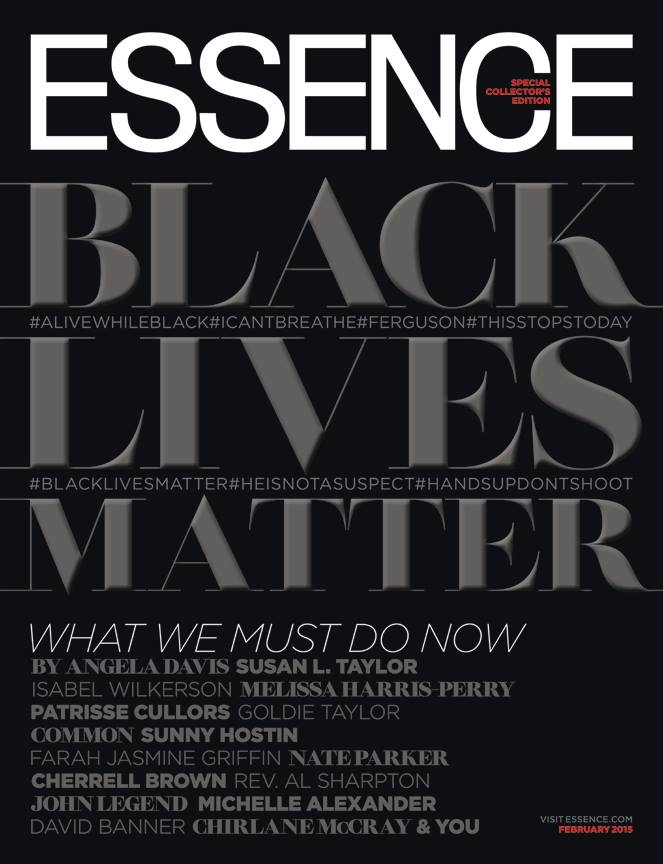 For the first time in its 45-year history, Essence magazine will not use a cover model.