Retha Powers, the editor of the magnificent and addictive new “Bartlett’s Familiar Black Quotations,” has a handful of all-time favorite sayings, or “micro-histories,” as she calls them. One is from the author of the foreword to her book,Henry Louis Gates, Jr.:
I rebel at the notion that I can’t be part of other groups, that I can’t construct identities through elective affinity, that race must be the most important thing about me. Is that what I want on my gravestone: Here lies an African American? So I’m divided. I want to be black, to know black, to luxuriate in whatever I might be calling blackness at any particular time — but to do so in order to come out the other side, to experience a humanity that is neither colorless nor reducible to color. Bach and James Brown. Sushi and fried catfish.
Powers, a life-long New Yorker, likes sushi better than catfish, but she revels in Gates’ point. She described the thrill when he accepted her invitation to write the foreword, transmitted in an email Gates sent from a plane. The two had not met.
“His work has been tremendously important to me,” Powers said over coffee near her home in Harlem. “I’m not an academic and, in a lot of ways, Dr. Gates mentored me from afar – in his far-reaching, accessible writing and his insistence on embracing Africa. He is not afraid of being an intellectual.”
In an interesting twist, both Powers and Gates are finalists for the NAACP Image prize in nonfiction, Gates for his PBS companion book, “The African-Americans: Many Rivers to Cross.” The Harvard University professor and chair of the Anisfield-Wolf Book Awards praised Powers, noting that she stands in a proud tradition: the first collection of black quotations published in 1898.
“In following them, Retha Powers both honors their work and reaffirms something essential about black culture: quoting or ‘sampling’ are both versions of the larger African American language practice of signifying,” Gates writes.
And so, “Bartlett’s Familiar Black Quotations” spans 5,000 years and samples politicians and poets, artists and visionaries from the Americas, the Caribbean, Africa, Europe and ancient Egypt. It moves chronologically, and veers from Ma Rainey to Lionel Richie, from Frederick Douglass to Michelle Obama, from Derek Walcott to Kanye West, from Mary McLeod Bethune to Mayor Marion Barry. The text is also rich in Anisfield-Wolf winners.
Writing in the New York Times, critic Dwight Garner praised it as “a necessary and preternaturally lively new reference book,” adding that “it also possesses something no other book of quotations quite does: a potent and sweeping narrative arc. It is possible to consume this book avidly from end to end.”
Powers hoped to evoke that response. She wanted these quick bites to excite the palates of readers to seek out a speaker or a period of history, to discover a new book, or thrill to the way Phillis Wheatley – the first African American woman to publish a book of poetry – and Rita Dove are in conversation across the centuries.
“There are a lot of years between Phillis Wheatley and Rita Dove but there are interesting parallels too,” Powers said. “Both are very concerned about an emotional reality, about place and principles. And both are black women writing about things that aren’t domestic.”
One difference, circa 1772, that Gates observes: “Wheatley had to submit to examination by the leading lights of Boston to ascertain that the poems she had written were not mere quotations of others’ work but her own original creations, the creation of a fellow human being.”
Powers includes much from music, and the both the book and the English language are richer for it. Nor does she flinch from the infamous: Colin Powell’s “There can be no doubt that Saddam Hussein has biological weapons,” and Marion Barry’s “Bitch set me up.” Her own taste runs to Zora Neale Hurston and other contributors to the Harlem Renaissance, an affection she strove to discipline with balance and tough editing.
At 44, Powers is quite mindful that the verdicts of history shift. She peppers her own conversation with quotes: “Stanley Crouch said, ‘If there is an intellectual highway, there is also an intellectual subway.’” This book, she said, is meant to be “browse-able, fun, delightful and surprising.” Who doesn’t perk up to learn – or remember — that Shirley Chisholm’s 1967 presidential campaign slogan was “Unbought and Unbossed”?
For an editor whose purse still contains stray scraps of “micro-histories,” Powers is excited that “Bartlett’s Book of Familiar Black Quotations” is being adapted into an app. She is particular fond of a remark by Anna Julia Cooper, born in 1858: “The cause of freedom is not the cause of a race or a sect, a party or a class – it is the cause of humankind, the very birthright of humanity.”
Powers also cottons to James Baldwin’s 1976 observation: “Identify would seem to be the garment with which one covers the nakedness of self; in which case, it is best that the garment be loose.”
As she awaits word on the NAACP Image prize, for which she will travel to Los Angeles, Powers might want to flip her book to a passage from “Beloved,” the novel by Anisfield-Wolf winner Toni Morrison: “Here . . . in this here place, we flesh; flesh that weeps, laughs; flesh that dances on bare feet in grass. Love it. Love it hard. Yonder they do not love your flesh . . . You got to love it, you! . . . Love your heart. For this is the prize.”
Philosophy Professor David Livingstone Smith kicked off the University of New England’s 2014 diversity lecture series with a talk on why “race” is a destructive concept.
The 2012 Anisfield-Wolf nonfiction award winner for “Less Than Human: Why We Demean, Enslave and Exterminate Others” stated his mission at the top: “I wish to liberate you. I do not think I will succeed, but I hope I will raise questions about certain beliefs you take for granted.”
Smith presented his audience with a slide of four individuals with light skin and typical European facial features. He then asked the audience if they could determine which two were, in fact, African-American. It proved puzzling for those assembled. (See the slide here.)
“Virtually every genocide that I know enough about has been a racialized genocide,” Smith told his listeners on the Maine campus. “The notion of race gets us into a lot of trouble.”
Smith, who has taught philosophy at the university since 2000, is also the co-founder of The Human Nature Project, which explores evolutionary biology and human nature. He is the author of seven books, including Less Than Human, a centerpiece text in several college classes, including the Anisfield-Wolf course at Case Western Reserve University.
Watch his entire talk below on the “race delusion” and share your thoughts:
Anti-racism activist Tim Wise joked that he was on his third visit to the University of Akron campus in the past 15 years and was pleased to see the audience increase each time.
Wise, 45, opened the evening by taking note of his privilege as a middle-class, college-educated, heterosexual white man. “I’m here because I fit the aesthetic for what’s necessary for white people to talk about racism in America,” he boomed. “People of color get up and say it all the time, but they get ignored. The real measure of post-racial America is when a black person can stand here and receive the same reception I do.”
Acknowledging his privilege is the cornerstone of Wise’s career. Born in Nashville, Tennessee, he received his B.A. from Tulane University, where he led an anti-apartheid student group. In the early 1990s, he moved south to become a coordinator for the Louisiana Coalition Against Racism and Nazism, whose mission was to extinguish the political future of white supremacist, David Duke. Wise moved on to community organizing in New Orleans’ public housing, and to work as a policy analyst for a children’s advocacy group.
His 2005 memoir, White Like Me: Reflections on Race from a Privileged Son, still sells briskly. It also still fuels debate on the soundness of a white man’s prominence in the anti-racism movement, endorsements by Angela Davis and Cornel West notwithstanding. And White’s public speaking habit of shifting into “white” voice to contrast with his “black” voice can be cringe-inducing.
Still, if there were critics tucked into the Akron crowd of 500 at E.J. Thomas Hall, they stayed quiet. Several African-Americans nodded vigorously as Wise laid out his points. “You can’t solve social problems with silence,” he argued. “I invite white folks to have the difficult conversations.”
Structural inequity should bother everyone, Wise said, and as the country’s demographics shift toward majority-minority, equality is more important than ever. “What binds us as Americans?” Wise asked the crowd. “It’s the myth of meritocracy — that anyone can make it if you try hard enough.”
Wise argued that this simplistic dogma ignores reality. “Here’s one fact for you: 500 white people in this country have the same accumulated wealth as 41 million black people,” Wise said. The crowd fell silent. “If you think that’s because those 500 people just somehow worked harder…no amount of education will help you.”
Wise swiveled his focus to a 1963 Gallup poll, when two-thirds of white Americans believed that blacks had equal opportunity for fair housing, education and employment, even as the civil rights movement was bubbling to a fever pitch.
Wise didn’t hesitate in calling such respondents out. “They were delusional,” he said, voice rising. “But there wasn’t any penalty for being ignorant of black and brown issues. It’s not on the test. Whatever white folks think is important, black people have to learn that. That will damn sure be on the test. White folks write the test. That’s the luxury of being the norm.”
Filmmaker Eduardo Montes-Bradley knew he wanted to make a film on Rita Dove. So the director of documentaries on former NAACP chairman Julian Bond and revolutionary Che Guevara decided to finance the project out of his own pockets.
“To have someone like Rita Dove expressing herself in generational terms by talking about her father and grandfather in her poetry was, to me, like a triple jackpot,” the Virginia-based filmmaker said. “I got the writer I was looking for. I got the story I was looking for, and I had it all right here at home.”
The result is “Rita Dove: An American Poet” built from family photos, home videos and interviews with its subject Montes-Bradley explores the former poet laureate’s formative years and asks how a girl from Akron, Ohio, became one of the most lauded poets of our time.
The film premiered in late January to a sold-out crowd in Charlottesville, Virginia, where Dove, 61, has been a professor at the University of Virginia since 1989. Boyd Tinsley, violinist with the Dave Matthews Band, gave remarks post-screening, followed by a few selected poems from Dove herself. Later, Dove sat for a brief Q&A with the director of University of Virginia’s creative writing program.
“What I love about the film is that it manages to maintain some mystery,” Dove remarked. “It resists the stamp of ‘this is Rita Dove.’ And his attention to the influence of music in my life — I am just extremely grateful for.”
Indeed, music is her center. The accomplished musician, whose talents extend to the viola da gamba (related to the cello), finds that both music and poetry “scratch the same itch.” Dove’s connection to music lead to the little-known story of African-European violinist George Polgreen Bridgetower, a protege of Ludwig van Beethoven. He inspired her 2009 book, “Sonata Mulattica.”
“I am obsessed with music,” Dove mused. “And poetry is a perfect vehicle for it because words are music. I’m obsessed with trying to capture what sensations music gives us.”
Watch footage following the premiere of the documentary, captured by Dove’s husband of 35 years, writer Fred Viebahn.
Wither the best book list? Inherently inane and crazy-making, these are also undeniably good conversation starters.
Amazon has posted the latest iteration: its best “100 Books to Read in a Lifetime.” It includes two Anisfield-Wolf prize novels: Junot Diaz‘ “The Brief, Wondrous Life of Oscar Wao”and Toni Morrison’s “Beloved,” as well as James McBride’s memoir “The Color of Water.” Also on the list is the immortal “Invisible Man” from Ralph Ellison, which won an Anisfield-Wolf Landmark Achievement, and books by Anisfield-Wolf recipients Edwidge Danticat and Louise Erdrich.
Of course, it is strange to see “Kitchen Confidential” make the cut, and the bizarre assertion that “Portnoy’s Complaint” is Philip “Roth at his finest.” The Amazon list tilts toward best-sellers, rather than an author’s best work.
Working another vein is the redouble Cosmopolitan Magazine, which has offered its list of the 10 best books to read after a breakup. Junot Diaz makes this list, too, this time for “This is How You Lose Her,” his sexy, harrowing short story collection. Surprisingly, he is joined by Adrian Nicole LeBlancfor her gold-standard of domestic reporting, “Random Family.” Cosmo editors give the somewhat spurious reason that the book is an absorbing distraction. May we add: and much more.
When 13-year-old Idris Brewster, subject of the thought-provoking documentary “American Promise,” is invited to a classmate’s bat mitzvah, he says he hasn’t much interest. None of the girls ever want to dance with him, and he has a good idea why.
“I bet if I was white, I’d be better off,” he says plainly.
His parents, filmmakers Joe Brewster and Michele Stephenson, are sitting off camera. They let the moment land.
Such incidents occur often in the two-hour film, which follows Idris and his best friend Seun Summers for 13 years at The Dalton School, a prestigious college preparatory institution in Manhattan. The documentary premiered on PBS in February and is available to viewers on the PBS website until March 6, 2014. Then it goes on sale.
Since it made the rounds at last year’s film festivals (winning a jury prize at Sundance), American Promise has sparked a new round of conversation about black male educational achievement. The numbers are sobering. Black children are more likely to have ineffective teachers and fewer educational resources, which may partly explain why black males are also twice as likely to drop out.
Brewster and Stephenson said their motives were simple. “We were confident that [attending Dalton] would set them on a course for academic success and we wanted to capture it all on film,” they write in their filmmaker’s statement. “This personal experience pushed us to expose the impact of the unique social and emotional needs of black boys on their academic performance.”
Serving a dual role as parents and filmmakers, Idris’ parents demand nothing but excellence from him and their younger son, Miles. They have no trouble expressing their exasperation when Idris doesn’t live up to expectations. After a particularly rough semester, Idris’ parents develop a spreadsheet to better manage Idris’ time. “Every hour of the day is accounted for,” Joe says.
Life at Dalton, which sends 30 percent of its graduates to Ivy League colleges, challenges all of its students, but those problems are magnified for African-American males. Dalton administrators talk on camera about how often black boys falter at the school, but suggest few solutions. The pattern is evident with Idris and Seun. They start out in kindergarten with a thirst for knowledge, but by sixth grade things are souring.
Parents of other black boys at Dalton express discomfort with the changes they see in their sons. And they wonder whether the sacrifice is worth it. Tuition runs $25,000 and some parents spend an addition $30,000 per year on tutors. They ask how their sons can compete.
The pressure is palpable as the boys as grow into young men. Seun is diagnosed with dyslexia and his parents hire a tutor to help him keep up. But the demands increase even as Seun—very bright and capable, according to his teachers—falls further behind. He transfers to a public school where the student body is predominately African-American. He begins to feel more comfortable, and this seems reflected in his work.
Idris remains at Dalton, where he is pushed (by his parents and teachers) beyond his perceived limitations. As he matures, his struggles with identity become more apparent. He learns the art of “code switching” — changing language, tone and posture as his company changes.
Brewster and Stephenson put together a companion book, Promises Kept, which expands on the film and offers parents and educators with resources to help close the achievement gap.
“Essentially, how well students do is how well we do as a nation,” Stephenson said. “The two are interlinked and intertwined. If we really want to compete at a level that makes sense to maintain, not only our status but our community and our values in this country, we have to take care of all of our children.”
Looking out over the multiracial crowd of more than 600 assembled at the University of Akron’s E.J. Thomas Hall, journalist Michele Norris paused in her remarks to make a quick observation.
“Within my lifetime, a theater with this composition would be unheard of, if not illegal,” she said, quickly adding, “And I’m not that old.”
The former host of NPR’s All Things Considered was brought to campus to discuss the growing acclaim of her latest venture, The Race Card Project. Norris, 52, revealed that the project—six-word submissions on race and identity—grew out of increasingly difficult conversations she had with her family on race and being black in America.
Born and raised in Minnesota, Norris was unaware of the collective “code of silence” her older relatives took about their upbringing in the segregated South. It wasn’t until then-Senator Barack Obama’s election prospects began to find firm footing that Norris’ family began to suffer from what she dubbed “historical indigestion.” Long-kept family secrets were now bubbling to the surface.
An uncle revealed that her father had been shot by a white policeman in the 1940s, a secret he never shared with his wife and children. Later, she was able to piece together the full story: as a young man in Alabama, he was on his way to a Constitution study meeting. New laws dictated that black voters needed to know the document intimately to pass the state’s new literacy tests. Norris’ father, Belvin, got into a scuffle with the policeman who did not want him to enter the building where the meeting was held. The gun went off and struck Belvin in the thigh.
Norris reflected on her discovery and her gratitude that her father sought to protect her from harsh realities of the world: “I was raised by someone who had every right to be mad at the world, and he chose not to. I benefited from that.”
Her probe into her family history culminated in her 2010 work, The Grace of Silence. On a whim, she headed to Kinko’s to print 200 postcards to hand out at speaking engagements, asking recipients to share their thoughts on race. “I wanted a window into the conversation you know is out here,” she said. “I wanted to learn about the history with a small ‘h’ — the kind available to you at the dinner table.”
Of that first batch of postcards, Norris received more than 60 responses. From there the project grew, with technology leading the way. Today people can send in their “race card” submissions through the website and Twitter account. To date, more than 38,000 six-word submissions have been archived with the help of college researchers. Thousands more remain to be cataloged.
Perhaps answering the question the audience most wanted to ask, Norris ended her remarks with her own “six words”: Still more work to be done.
In her influential best-seller, “The New Jim Crow,” law professor Michelle Alexander dissects the devastating racial consequences of “locking up and locking away” more than two million American citizens. And in her frequent public appearances, Alexander elaborates on the paradox of her subtitle: “Mass Incarceration in the Age of Colorblindness.”
She drew a standing ovation on a recent, frigid night at Baldwin Wallace University near Cleveland. Speaking in a steady, clear voice, the Ohio State University professor delivered a portrait of contemporary racism difficult to hear: The U.S. prison population quadrupled in the last 30 years, fueled, Alexander argues, by a war on drugs applied disproportionately in communities of color. There are more American prisoners now than there were slaves in 1850 — before the Civil War. And black children now have less chance of being raised by two parents than black children born into slavery, a system notorious for dismantling families.
“We all know large numbers of black men are locked away in cages,” she told more than 800 listeners, some packed into an overflow room. “And we know people released from prison face a lifetime of discrimination, scorn and exclusion.” She listed some of the hundreds of work-required licenses barred for people with felonies — including in some states, a barber’s license.
“I now believe mass incarceration is the new Jim Crow,” said Alexander, 46, dressed plainly in a gray jacket, brown blouse and brown slacks. “People sometimes react with shock: What about Barack Obama? What about Oprah Winfrey? What about Colin Powell?”
The comedian Steve Colbert did, asking, with faux severity: “Why did not black people just say no?”
Alexander told him that solid research shows African Americans use illegal drugs at the same rates as other races, but are much more frequently prosecuted. She would like the country to return to its 1970s levels of incarceration, legalize marijuana, and end the war on drugs.
The American people twice elected a black president — a fact that Alexander believes helps mask a new system of racial caste, where nobody drinks at a segregating water fountain, but jobs, housing and food stamps are all blocked from those trying to re-enter society from prison. Poor communities are saddled with decrepit schools, while gleaming, high-tech prisons operate for profit. She cited the research of William Julius Wilson: in the 1970s, 70 percent of African-Americans in cities held blue-collar jobs; today the figure is 28 percent.
“The one thing that poor folk of color can ask for and get are police and prisons,” she said dryly. The daughter of the late John and Sandra Alexander, a senior vice president for ComNet Marketing group in Medford, Oregon, Michelle graduated from Vanderbilt and Stanford universities, and clerked for Supreme Court Justice Harry Blackmun. Her sister, Leslie Alexander, is a professor of African American studies at Ohio State University. Her husband, Carter Mitchell Stewart, is a U.S. Attorney for the Southern District of Ohio.
Even as a civil rights lawyer, Alexander said she awoke to the new Jim Crow slowly, reluctantly: “There was a time when I rejected those comparisons out of hand as exaggerated and unproductive.”
No more. Her book won an NAACP Image award in 2011, and has been firing conversations in book clubs, churches and universities since it arrived in paperback. Some students at Baldwin Wallace took careful notes; others scrolled their smart phones. Partisans of the Communist Party sold newspapers at the door, and one man who identified himself as a lifelong member asked Alexander to declare her allegiances.
“I am someone who believes in justice,” she said carefully. “I am for basic human rights and economic justice for all. I resist labels and I am not going to assign one to myself.”
Her advice to students: “Think about movement building and not simply policy reform.” She pointed to the success of gay marriage advocates who bent public opinion: “Politicians have no choice but to respond.”
Ask Nichelle Gainer why she decided to create Vintage Black Glamour, and her answer is simple: She saw a need.
As a writer, Gainer learned to research, which often led to beautiful historic photographs of African-American artists, actors and political figures, all hidden away in the corners and file cabinets of libraries and academic institutions. Why haven’t more people seen these? she wondered. Out of that question, Vintage Black Glamour was born.
“African-Americans who have an interest in American history that includes black people almost have to become amateur detectives and part-time scholars to track down information and that is ridiculous,” she said from her home in New York City.
For Gainer, who attended the creative writing program at New York University, the project is pure “edutainment.” The history buff likes to add context wherever it is available, providing a mini history lesson to match the photos. She has been working with a new imprint, Rocket 88, to bring out a text version this spring.
Gainer said Vintage Black Glamour has a deeper meaning than simple nostalgia over beautiful dresses and sharp suits.
“How we looked and how we put ourselves together…a lot of it was self-preservation and representing an image of how black men and women were,” Gainer explained in a recent interview. “Most vintage photos of African-Americans that get wide exposure tend to be very sober, and even sad.”
These days, Vintage Black Glamour has more than 215,000 fans on Facebook, a popularity that doesn’t surprise its creator.
“People write comments on my social media channels all the time saying things like, ‘I’ve never seen this photo before!’ or ‘I’ve never even heard of this person!'” Gainer said. “And then they go on to talk about what has been left out of the classroom and history books over the years and how that shapes perceptions of African-Americans. But black history is American history — it’s one of my mantras!”
Washington Post reporter Wil Haygood stood in the pulpit at the Amasa Stone Chapel on the Case Western Reserve University campus, thanking university President Barbara Snyder for an impressive introduction and riffing on whether he was a strong enough high school student in Columbus, Ohio, to have been admitted to the Cleveland research institution.
He doubted it. “I graduated ‘summa cum lucky,’ he riffed.
All joking aside, Haygood’s intellect and credentials are what carried him to the university to deliver its keynote at the annual Martin Luther King Jr convocation. For more than 20 years, Haygood has covered some defining moments across the globe. As an international correspondent for the Boston Globe and Washington Post, he was captured by rebels in Somalia while covering its civil war and stood outside the South African prison when Nelson Mandela was released. He spent 33 straight days on the ground in New Orleans after Hurricane Katrina. And the 2011 Guggenheim fellow delivered his keynote without a single note.
Haygood indicated that his most important assignment might well have been his discovery and coverage of one man, Eugene Allen, a retired White House butler who served eight presidents over his 34 years.
In 2008, Haygood was reporting on then-Senator Barack Obama when a North Carolina campaign stop gave Haygood a strong sense that Obama would win. Reflecting on the historical significance of the first African-American president, he asked for time off the campaign trail to find a White House staffer who served dduring the civil rights movement, for whom the election would have special meaning. With his editor’s limited blessing (he gave Haygood two weeks), he started searching, and took a phone call from a woman who said that a fellow named Eugene Allen would fit the bill. Haygood called 55 “Eugene Allens” listed in the Washington, D.C. phone book. He struck gold on the 56th call.
Their initial meeting convinced Haygood this Eugene Allen personified the piece of history he had been looking for. As the conversation progressed, Allen invited Haygood into the basement of his quiet D.C. home. As he flicked on the light, Haygood was struck by the testimony of objects: watercolors painted for Allen by Dwight Eisenhower, a tie clip from John Kennedy and framed photographs of the butler with each American president.
“Have you ever told your story before? Has anyone ever written about you?” Haygood asked.
“If you think I’m worthy, you’d be the first,” Eugene replied.
Haygood’s journalistic instincts led to a front-page story, “A Butler Well Served By This Election,” published three days after the 2008 election. It quickly got Hollywood’s attention. The Weinstein Company bought the rights to the story and cast Oscar winner Forest Whitaker to portray Cecil Gaines, the fictional character loosely based on Allen. While the movie went into production, Haygood turned to a book version, “The Butler: A Witness to History,” filling in the dignity and details.
Haygood and Allen were VIP guests on that cold January day that Barack Obama was sworn in as the nation’s 44th president. “You never dreamed that you could dream of this moment,” Haygood recalls Allen saying. “He said ‘dream’ twice – that’s how unbelievable it was.”
Allen died in 2010 at 90. President Obama released a statement read at the funeral, thanking him for his years of service and citing Allen’s life as important piece to American history.
“If I had to do it all over again, I think I’d do the same thing,” Allen said. “After all, there were many things that I never would have seen in life…I’ve seen every leader in the world—kings, queens, prime ministers. I was loyal to the White House, I loved it. After so many years, it was just a part of me.”
Kerrick Woyshner, 18, was a scholar in the first college-level Anisfield-Wolf class, pioneered by Dr. Lisa Nielson at Case Western Reserve University. Students read essays, poems and books by Anisfield-Wolf Book Award winners, attended the September awards ceremony and did original research on topics inspired by the course.
“I never realized what motivated my hand to click on the ‘Reading Social Justice: The Anisfield-Wolf Book Awards’ class this summer,” Woyshner wrote. “I wanted something new. Though I hailed from a conservative, all-male Catholic high school, I plan on continuing this education my entire life, striving to benefit those who don’t have the resources so that I may one day become the Martin Luther King or, rather, the Kerrick Woyshner of social justice.”
A student from Hamburg in western New York, Woyshner decided to contrast the work of two Anisfield-Wolf Book Award winners: the Rev. Dr. Martin Luther King Jr., and Nobel Laureate Wole Soyinka.
By Kerrick Woyshner
The writings of Dr. Martin Luther King Jr. have left an indelible mark on humanity and its quest for racial equality. In them, King presents his campaign of nonviolent protesting that built the framework for the Montgomery Bus Boycott, the Birmingham Lunch Counter Sit-ins, and the March on Washington. King described these principles in his resounding first book, Stride Toward Freedom, which won the Anisfield-Wolf prize in 1959.
I argue that the life and writings of King, particularly in “Letter from Birmingham Jail”, serve as the United States’ most important references for effective and successful social change.
Born on January 15, 1929, in Atlanta, Georgia, King was the son and grandson of ministers who pioneered the struggle for African American equality. His grandfather, A.D. Williams, was one of the first heads of the Georgia chapter of the NAACP while his father, Martin Luther King, Sr. fought for equal salaries for African American teachers.
King skipped several grades and entered Morehouse College at 15 in search of “some intellectual basis for a social philosophy.” Torn between medicine, law, and the ministry, King chose the ministry. His study of social philosophers such as Plato, Aristotle, Rousseau, Locke, and Hegel, in addition to his theological studies, fed his ability to organize and speak eloquently to the subjugation of African Americans. The most important influence, however, on the collegiate King was India’s leading peace activist, Mohandas Gandhi. “The spirit of passive resistance came to me from the Bible and the teachings of Jesus,” King wrote, “…The techniques of execution came from Gandhi.”
Interestingly, as Gandhi was criticized by British officials for his Quit India speech, King was criticized by eight white, Birmingham clergymen in an open letter titled “A Call for Unity.” The eight called King’s coordinated marches and sit-ins “unwise and untimely,” which prompted King’s response: his famous “Letter from Birmingham Jail.” King demonstrated to his eight critics, the entire city of Birmingham, and the citizenry of the United States that his nonviolent movement for civil rights had never been more wisely and timely conducted, and he did it writing a letter upon scraps of wrinkled paper scavenged while locked up in Birmingham Jail.
King compared himself to Paul, one of Jesus’ apostles and one of Christianity’s predominant figures of the Apostolic Age, and to the early prophets of Christianity in bolstering his reasons for not sitting idly while the injustices of Birmingham were hindering the justice of humanity. “You deplore the demonstrations that are presently taking place in Birmingham,” King wrote to his critics, “But I am sorry that your statement did not express a similar concern for the conditions that brought the demonstrations into being.” King’s poignant response was persistent, powerful, and public.
Four months after King published his letter, he helped lead the March on Washington, making clear that his effort was not solely for the advancement of African American citizens, but for all races and religions that have endured the malicious sting of dehumanization globally.
Today, the Anisfield-Wolf Book Awards continue to recognize the Martin Luther Kings of society, the writers and orators who advocate for equality for all men and women regardless of their creed, color, disability or sexual orientation. The recipient of the 2013 Anisfield-Wolf Lifetime Achievement Award, Wole Soyinka, is a prime example. In his book The Man Died, Soyinka presents a stirring account of his time imprisoned in solitary confinement during the Biafran War in Nigeria.
In the same way that King recognized and exposed political and social injustice, Soyinka builds on King’s mission through moral obligation and immediate action, writing, “The man dies in all who keep silent in the face of tyranny.” Soyinka, whose literary and political gifts make him somewhat of a modern-day aggregate of Nelson Mandela and Martin Luther King, Jr., spoke in September of the need to preserve libraries, safeguard and extend education and bend toward the arc of justice that King outlined a half century ago.
King’s “I Have a Dream” message preached a solution to the contradictions and paradoxes in society’s deviation from the Declaration of Independence: the end of racism. By eliminating discrimination, the United States inches closer to its intended goal of granting life, liberty, and the pursuit of happiness to all of its citizens. This synthesis of equality and understanding, supported by work of Wole Soyinka and the other winners of the Anisfield-Wolf Book Awards, set King apart.
I believe in social justice in the same way King did. While I firmly believe those who do evil will be held to the principle of karma, it is not my place to perform such evil unto them. Similarly, King recognized that injustices cannot battle injustices — he had to kill his enemies with kindness. What’s more, King put his life on the line. He never knew when his last speech was going to be, when his last book was going to publish, what his last day would dawn, so he made each one count. He looked at wrongdoings and proposed peaceful, non-violent corrections. In this way, King viewed the world differently, so that, to him, me, and the 200,000 supporters assembled at the Lincoln Memorial before him, 1963 was not an end, but a beginning.
Late last year, the New York State Museum in Albany received an ordinary package – reel-to-reel tapes donated by the late Enoch Squires, a radio technician. As staff worked their way through the items, one tape jumped out. It was labeled “Martin Luther King Sept. 12, ’62.” This bequest is the only known recording of King’s speech on the centennial of the Emancipation Proclamation, delivered at the Park-Sheraton Hotel in New York City.
This 26-minute speech featured a more measured cadence than his “I Have A Dream” speech, but the similarities emphasize King’s discontent with the slow march to justice. He diagnosed U.S. race relations as a “pathological infection” that has hampered the social health of all citizens. King drew upon the language of the Declaration of Independence and the Emancipation Proclamation to reflect on the promises of equality America had not yet kept to African-Americans.
“We do not have as much time as the cautious and the patient try to give us,” King said. “We are not only living in a time of cataclysmic change – we live in an era in which human rights is a central world issue. The shape of the world today does not afford us the luxury of an anemic democracy.”
Less than a year later, King andJohn Lewis(also an Anisfield-Wolf Book Award winner), Bayard Rustin and three other leaders organized the historic 1963 March on Washington for Jobs and Freedom, propelling the civil rights movement into primetime and solidifying its place in history.
Watch here the combined audio and visual here:
Arjun Gopinath, 17, participated in the first college-level Anisfield-Wolf class, pioneered by Dr. Lisa Nielson at Case Western Reserve University. The class read essays, poems and books by Anisfield-Wolf Book Award winners, attended the September awards ceremony and did original research on topics inspired by the course.
“Being an international student, I had this paranoia that my level of writing wouldn’t match the level of an average American student, but the small seminars – such as the Anisfield-Wolf course – have helped me get in sync with writing and not be afraid of it anymore,” wrote Gopinath, who grew up in Bangalore, India.
His essay on Far From the Tree is one of a selection from students featured on this site.
By Arjun Gopinath
There is a huge variety of parenting books available in the bookstore: Parenting for Teenagers, How to take care of your Asian daughter, and so forth. But there was one missing from the self-help section that I found on the shelf reserved for bestsellers: Far from the Tree by Andrew Solomon. After hearing Solomon speak at the Anisfield-Wolf ceremony, I was eager to read this book that explored the families of children who had what Solomon calls “horizontal identities.”
Once I opened the book, I was lost in the beauty of Solomon’s writing. The sad tales and the happy tales of different families left me aghast.
Solomon proposes that children who are different, who have fallen “far from the tree” derive their identities from others like them: “Someone has an inherited or acquired trait that is foreign to his or her parents and must therefore acquire identity from a peer group.” The writer looks at the families of children who are physically or mentally disabled, gay, prodigies – 10 categories in all — and asks how they develop horizontal identities.
In interviews with more than 300 families, Solomon invites them to the front of the room to share little incidents and grave difficulties. In many ways, he is the perfect writer for the subject— nuanced, thorough, humane, and a gifted stylist. As he works toward the root of this conflict, Solomon pushes horizontal identity as far as it will go. He examines deafness and dwarfism, Down syndrome, autism, schizophrenia, multiple severe disability, early genius, conception through rape, criminal behavior, and transgender — bringing new light to these conditions by considering them across category. He lets the families talk, and when bonds within families begin to fray, he seeks to understand what went wrong.
In one instance, David and Sara Hadden had the seemingly perfect life – married in their early twenties with plum jobs in the heart of New York City. Soon, Sara gave birth to a first son, Jamie, in August 1980. Three days later, Jamie turned blue. The infant’s breathlessness soon transitioned into salt-and-pepper pigmentation of his retina. Doctors said that Jamie would be completely blind and severely retarded, incapable of speech, feeding himself or urinating on his own. But the doctors also assured the Haddens that Jamie’s condition was anomalous, and so Liza was born when Jamie was four, and Sam followed four years later. The condition that disabled Jamie skipped Liza but struck Sam with a greater ferocity. After the family won a legal settlement, Jamie and Sam went to a group home. Tragically, an oversight by a caretaker let Sam drown in a bathtub. Despite their immense grief, the Haddens refused to prosecute the caretaker. Why? “It could have been any of us.”
Parenting is an extremely difficult occupation. Yes, I used the word “occupation.” And children are terrible employers. When a child requires extra care, there is no way to quantify the stress and cost. Parents of disabled children may fight for their children’s rights, may give up jobs and outside lives. The Donovans, whose son Liam suffers from the CHARGE syndrome, asked themselves if he would have been better off dead than alive. For parents of children in such crises, morals can conflicts with parental love.
Solomon reaches into his own life for one example.
One day while shopping for shoes in New York, little Andrew – unlike his brother –picked a pink balloon over a blue balloon offered by a salesman in an Indian Walk Store. His mother persistently nudged him to pick a blue balloon, insisting “it was his favorite color.” Much later, she told him, “When you were little, you didn’t like to do what other kids liked to do, and I encouraged you to be yourself, although I sometimes think I let things go too far.”
In this book, the reader travels trough unseen incidents and unheard narratives that can truly change one’s view of the world. We glimpse, for example, how a transgender child, Kim struggled for years to tell her parents about her transition, and yet her mother accepted it with no qualms (“I love my child; the intelligent, caring, humorous person is still there”). We witness the parents of a drug-addicted criminal take in the granddaughters.
“Solomon moves in the opposite direction – instead of starting with the principles and applying them to specific conditions, he’s starting with the conditions and progressing toward where they converge,” writes the critic Nathan Heller of The New Yorker. This is a quite fascinating approach.
As Solomon finishes one chapter and begins the next, the reader moves from the end of one emotional rollercoaster to the beginning of the next. “Far From the Tree” engenders empathy and shifts in thinking. Solomon considers the profound change cochlear implants have made for many in the deaf community, and asks the painful question of whether parents of gay children might embrace a similar device to make their child straight.
Solomon writes, with frankness, “In my adulthood, being gay is an identity; the tragic narrative my parents feared for me is no longer inevitable.” In an effort to recast his fraught relationship with his mother and father and their reaction to his sexuality, he began studying other forms of horizontal identity, and what he discovered is truly astounding.
I wish Solomon had tucked in a chapter on children conceived through sperm banks, and perhaps another on interracial adoptions. At more than 900 pages, Far from the Tree is a “cross-section of something that defies sectioning,” an exploration of difference as it shapes family life. The book brims with science, medicine and psychological research, and it breaks ground by reducing fear and opening questions about new horizontal identities.
When Robert Runcie became the new superintendent for Broward County schools, a populous part of metropolitan Miami, Fla., he knew the rising tide of student arrests needed reversing.
In 2010 and 2011, police made more than 1,000 arrests at his schools, and nearly 70 percent were for non-violent misdemeanors – such as truancy or smoking. These arrests disproportionately affected his African-American and Latino students. Even though students of color were 40 percent of the student body, they accounted for 71 percent of arrests.
A coalition of concerned citizens, community leaders and elected officials pushed for a new policy that would reduce the number of students with criminal records. The new initiative, started at the beginning of the 2013-2014 school year, redirects students to counseling and support services instead of reporting minor infractions to the police.
This initiative lines up with a policy shift advocated by the U.S. Justice Department. “A routine school disciplinary infraction should land a student in the principal’s office, not in a police precinct,” said Attorney General Eric Holder.
Both the Justice Department and the U.S. Department of Education released guidelines in early January asking districts to institute fairer policies, noting that “racial discrimination in school discipline is a real problem.” The guidelines suggest eliminating out-of-school suspensions, providing conflict resolution training for teachers, and collecting data on infractions to monitor any potential discrimination.
The new policy is considered a correction to “zero tolerance” policies that spread in the early 1990s. Zero tolerance forced school administrators to call the police whatever happened, stripping school staff of discretion and case-by-case judgment. Under zero tolerance policies, students of color are three times more likely to face suspensions or expulsion than white students. Responding to this data, the ACLU and the NAACP have pressed for better, fairer approaches to school discipline.
Education Secretary Arne Duncan stressed schools can be safe and orderly and “keep students in class where they can learn.”
Andrea Lau, 18, was a student scholar this past fall in the first college-level Anisfield-Wolf course, pioneered by Dr. Lisa Nielson at Case Western Reserve University. The class read essays, poems and books by Anisfield-Wolf Book Award winners, attended the September awards ceremony and did original research on topics inspired by the course.
“The pieces of literature that we read and the stimulating discussion held in this class have left a profound impact on my perspective of the world and my understanding of how society participates in equality and prejudice,” wrote Lau, who grew up in New Jersey.
In coming weeks, this site will feature a selection of work from these students.
By Andrea Lau
My story of growing up in America as a first-generation Chinese-American is not particularly individual or unique, but it has shaped me as a person and American citizen, and I am proud of my background in my own low-key way. This is not a sob story, nor is it a sentimental essay of how I and my parents struggled to fit into a society designed against us. I write this piece as a chronicle of my personal journey to “find my true self”; to document my struggle to identify myself and locate a true definition that I can be content to use in detailing my make up as a person.
It may be true that my favorite Disney princess is Mulan, and it so happens that my favorite dishes include rice or noodles. I have difficulty watching Caucasian girls’ makeup tutorials online because my eyes are genetically differently than theirs. These descriptions already categorize me perfectly into the image of the stereotypical Asian American. However, I have never been one to believe in stereotypes because there are always more complex and interesting storylines underneath. I watched Mulan all the time as a child, mainly because I admired her bravery, cleverness, and humility.
The Little Mermaid was another childhood favorite, yet society does not immediately believe that I have fish friends and live in the sea. Furthermore, rice and noodles are present in a wide range of cultures outside Asia and are enjoyed by many races. Finally, I can’t even follow makeup techniques for Asians because my features, like my inner personality, seem to be a hybrid of both races’ characteristics. My upbringing and environment throughout my socialization have created my personality and the life perspective I have today.
Generally, I simply think of myself as an American individual who just happened to grow up in a Chinese household: the paleness of my skin and knowledge of another language have never played a defining role in my life. I attribute this freedom to my parents, who never forced things like Chinese school upon my childhood. If they had urged me to attend, like my very traditional grandmother wanted them to, I probably would have despised it as a child; viewing it more as a prison and burden than the intended enrichment of my culture and an education of another dialect of my native language. As a result, my inability to speak Mandarin has followed me through life, haunting me and wreaking its inconvenient effects all too often.
Possessing a mediocre capacity to speak Cantonese only allows me to communicate with my relatives on an elementary level. As a matured and more developed young adult, I am now equipped with the knowledge and hindsight to regret my incompetence in the dialect which a large portion of the world speaks. The skill with which my parents mastered English has always been a blessed convenience for me, but I now realize that it is just another factor that contributed to my lack of proficiency in Chinese. This inconsistency illustrates one struggle that my identity faces – I may be a well socialized American citizen who can easily blend in with the white majority, but I also regret the lack of a connection I have to my ethnic character.
Zadie Smith’s “Speaking in Tongues” dictated a powerful message to me, and in reading it I realized how similar my struggles are to those of my peers. While I have never had any trouble communicating with my parents in the same kind of language I use with school colleagues, conversing with relatives has always posed an obstacle, and I indeed had to alter my discourse and diction in order to facilitate conversation and understanding. From another interesting angle, whenever I speak to family friends, who, like my parents, were Chinese immigrants educated in America, I have little trouble doing so, and I actually admire how cultured and knowledgeable they are. They represent who I strive to be through hard work in hopes of rising through society’s ranks.
Racism has never had a significantly negative affect on my life. In a society that is fortunately quite accepting of the minority I am a part of, it is more interesting for me to observe the public’s attitudes toward other races. My lifestyle has never fulfilled a specific stereotype for the typical Asian American, and I have always taken a secret pride in not simply conforming to yet another social standard for who an individual should be. Unfortunately, I am no better at mathematics or academia than the average non-Asian person who studies diligently.
The widely publicized memoir of the so-called “Tiger Mom,” Amy Chua’s Battle Hymn of the Tiger Mother, in 2011 could not be more different than the household in which I was raised. Surely, I was familiar with the traditional and strict parenting she swore by because I grew up surrounded by figures who inflicted small dosages of these techniques on my upbringing. However, I consider myself lucky that my family approached parenting from a more understanding and flexible perspective, and it is why I am content with the way I conduct my life today. I am fortunate that my race and background have never hindered me from any of my ambitions, and the cultural flavor that has been added to my life has only enriched me and made me more interesting as an individual.
This class introduced me to the intriguing concept of intersectionality: the idea that no individual in society has a single label. A person is not classified by his/her gender alone, but also by his/her race, and any other factor that influences how he/she is perceived. Several, sometimes conflicting, identities in tension are what truly characterize a person and their role in society. I am not simply an Asian, but an Asian woman. That means my experience in the world is different from that of an Asian man, who is respected at least for his sex, or a Caucasian woman, who rallies for women’s rights separately from ones against racism. As a result, my experience is unique and original, and reading the works of and hearing the voices of Asian American women is even more enriching.
I have indeed grappled with how true I am to my heritage, and wonder if I struggle more with being a Chinese person Americanized by society, or being an American person endeavoring to reestablish connections to my culture. Reading pieces from the Anisfield-Wolf Book Awards has enlightened me to the idea of multiple cultural personalities and living in society with these labels, and I embrace both the benefits and obstacles that come with my heritage.
Affordable classes on African-American topics for anyone who wants to take them — that’s the gist of Professor Zachery Williams’ vision.
Beginning in February, residents in Northeast Ohio will have the opportunity to take classes in spaces around the region as part of his CommUniversity, a grassroots effort to provide low-cost African-American history courses to the general public. Community organizations like the National Institute for Restorative Justice have signed on to lend their meeting spaces for classrooms, and professors from local colleges, as well as community members, have been invited to teach.
For Williams, an tenured professor of African-American history at the University of Akron, this is a project years in the making. Williams, 39, grew up in South Carolina, and ventured north for his doctorate at Bowling Green State University, where he studied W.E.B. DuBois’ origins as a black intellectual. His research culminated in his first book, In Search of the Talented Tenth: Howard University Public Intellectuals and the Dilemmas of Race, 1926-1970. While at Bowling Green, Williams and his colleagues formed the Africana Cultures and Policy Studies Institute, a think tank that applied African-American studies to long-standing social problems. It was, in essence, the incubator of CommUniversity.
“Too many people for far too long have been left to the margins,” Williams explains. “There’s this view that it’s us versus them. That’s the value of adult education. It’s proof that every day people can create something magnificent. ”
The model of a “community university” has existed in some forms for decades, Williams concedes, but he breaks new ground in two ways: His project is independently funded and he is focusing the courses. He’s particularly interested in the intersection of race and public policy and getting out of the “ivory tower” to find promising solutions.
“We’ve been grappling with income inequality, mass incarceration, and public housing for quite some time, so where these are viable solutions?” he said. “There’s a consensus that everyday people don’t know what’s best for them, but experiences matter in solving issues.”
Williams believes the answer to some of these pressing issues may germinate in a future CommUniversity classroom.
His current fund-raising continues until the end of January. More information at ScholarGifts.com.
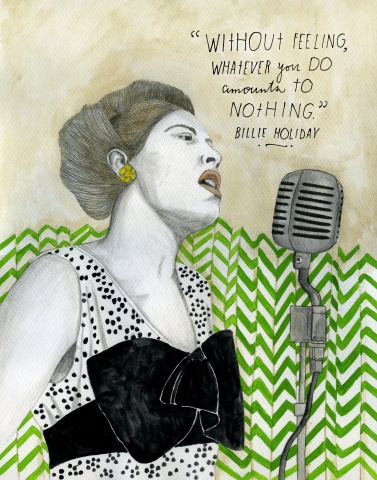
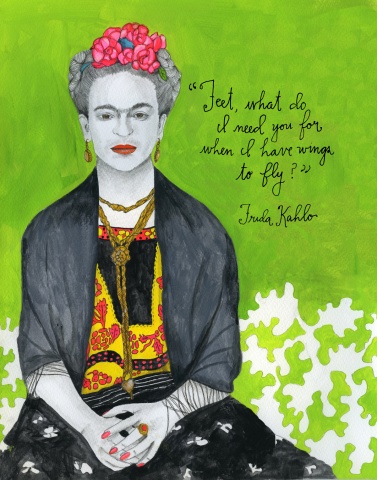
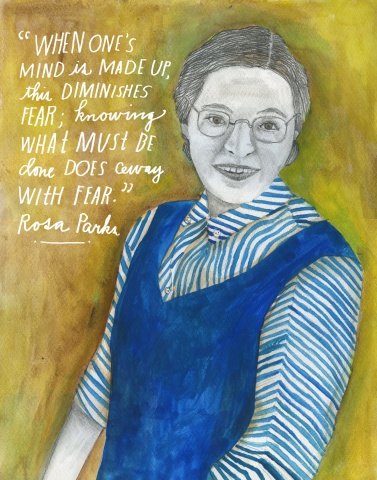
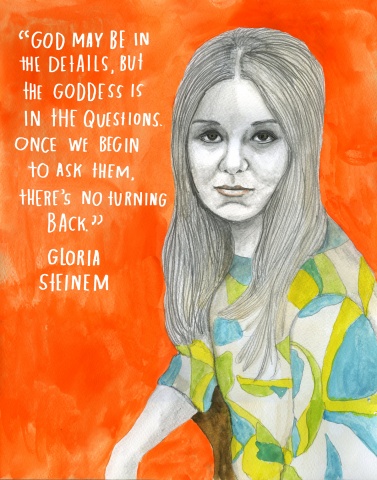
Unlike most of us, illustrator Lisa Congdon kept her 2013 resolution, for the entire year. We—and the internet—are better for it.
In late 2012, Congdon, who lives and draws in Oakland, Calif., decided with writer Maria Popova (a Bulgarian living in Brooklyn, N.Y) to celebrate an influential woman each week in 2013. They titled the resulting collaboration, The Reconstructionists, and set up a Tumblr page to house their work: a new portrait and short essay on each of their subjects went live every Monday.
“We didn’t intend for this to be inclusive of all noteworthy women or even the top 52,” Congdon said. “That would have been impossible. We didn’t come close to featuring all the women we wanted to, but we are hoping we exposed people to women they might not have known about otherwise.”
The duo highlighted Margaret Bonds, the gifted black composer and pianist who was the first woman of color to perform with the Chicago Symphony. They featured blues singer Billie Holiday, NASA pioneer Sally Ride, and competitive swimmer Dana Nyad.
Congdon doesn’t plan to continue, though there is interest in turning the project into a physical book. For now, though, “it lives on the internet where people can learn from and enjoy it for a long time at no cost,” she said. “And that feels like a good thing to us.”
View some of our favorites from the collection below:
Almost 18 years ago in The New Yorker, Anisfield-Wolf Jury Chair Henry Louis Gates Jr. profiled the intellectual and novelistAlbert L. Murray, concluding, with a flourish, “this is Albert Murray’s century; we just live in it.”
That century ended August 18, 2013, when the Alabama-born man of letters died in New York at age 97. Gates memorialized the man, writing “Murray will be remembered as one of the great aesthetic theorists of American culture, specifically for his concept of the ‘blues aesthetic,’ which he identified as the subtext and deep structure of what, to the last, he thought of as Negro-American culture.”
That hyphen was inviolate to Murray.
In his magnificent 1970 essay collection, The Omni-American, Murray states, “American culture, even in its most rigidly segregated precincts, is patently and irrevocably composite. It is, regardless of all the hysterical protestations of those who would have it otherwise, incontestably mulatto.”
He took a dim view of separatism of all stripes. “Improvisation is the ultimate human (i.e. heroic) endowment” wrote Murray in The Hero and the Blues. In 1997, he came to Cleveland to accept an Anisfield-Wolf Lifetime Achievement award.
Murray – friend of Duke Ellington, who called him “the unsquarest man I know,” and confidant of novelist Ralph Ellison since their Tuskegee Institute student days – lived to see a 44th American president embody some of his own notions. The public continues to wrestle with Murray’s ideas today – as indicated by the comment thread on the man’s front-page obituary in the New York Times. Better reading is found in Murray’s books. His novel, “Train Whistle Guitar,” is a felicitous place to start.
On March 21, 2013, another literary titan died at age 82 after a brief illness. Chinua Achebe (pronounced CHIN-you-ah Ah-CHAY-bay) was only 28 in 1958 when William Heinemann Ltd. of London published his first book, a brisk Nigerian novel, Things Fall Apart. Achebe took the title for his anti-colonial masterpiece from a Yeats poem, “The Second Coming,” and—in 209 pages—remade the global literary conversation.
Things Fall Apart is now a classic—with more than 10 million copies sold—and taught around the globe. Philosopher and Anisfield-Wolf winner Kwame Anthony Appiah praised Achebe for his moral intensity, writing: “It would be impossible to say how ‘Things Fall Apart’ influenced African writing. It would be like asking how Shakespeare influenced English writers or Pushkin influenced Russians.”
The novel chronicles how a proud Igbo man named Okonkwo is brought low in late 19th-century Nigeria. It stands at the headwaters of contemporary literature, and, as Appiah noted, “opened up the magic casements of African fiction.”
Two years ago, writers Toby Barlow and Sarah Cox got together to discuss Detroit.
Negative headlines pounded the city’s reputation, but the duo knew there was more to Detroit than foreclosures and shuttered factories. Barlow proposed creating a writer’s residency within the city, but Detroit didn’t need temporary residents—it needed permanent ones. A September estimate put the number of vacant homes at 78,000, or one-fifth of the housing stock.
“We wanted more intelligent, interesting writing about Detroit,” Cox said. “So we looked at how we could make that happen.”
The board members pooled their money to buy two homes. A third home was donated to the group. They formed a mutually beneficial partnership with Detroit Young Builders, a vocational training program for city youth. The construction team would provide the labor to rehab the homes. Write A House launched its IndieGogo campaign this week to raise $25,000 to finance the renovation.
Applications for the residences will be available in spring 2014, hoping to select writers who are committed to Detroit for the long haul. “We want people to know what they’re getting into,” Cox said. “You’re living in Detroit and you need to be comfortable with that.”
The judges include former National Poet Laureate Billy Collins, poet Major Jackson, and writer and activist Dream Hampton. Writers don’t need to be Detroiters to apply. The winners will live in the house rent-free for the first two years and will be responsible for paying insurance and property taxes. After that, the writer will receive the deed to the house, free and clear.
Write A House also stipulates that the winners participate in Detroit’s literacy scene, but will let those individual decide how. “They could host a reading series or tutor kids,” Cox explained. “We’ll leave it up to them. We want someone who feels like they’re part of the community.”
On the day Nelson Mandela’s body was lowered into the ground, Congressman John Lewis raised his voice half a world away to exhort the December graduates of Cleveland State University to begin lives of activism and “to get into good trouble.”
Lewis, 73, told the almost 1,000 graduates that he had been “very moved” in Johannesburg, South Africa, as part of the U.S. delegation to the Mandela memorial service.
“Don’t give up; don’t give in; go forth and be good citizens, not just of America, but citizens of the world,” Lewis said, connecting his listeners to Mandela’s legacy and the American Civil Rights movement. “This is your day, not mine,” he said, with more than the snowy date on the calendar in mind.
A man of stillness and humility, Lewis moved his right hand over his heart as he accepted an honorary doctorate from Cleveland State, the latest of more than 50 such academic honors. “I’m delighted and very pleased to be with you on this important occasion,” he told his hosts. “Thank you for honoring a poor boy from rural Alabama. I was not born in a big city like Cleveland.”
But he became a man of momentous deeds – an architect of the 1963 March on Washington, a veteran of more than 50 arrests and a founder of the Student Nonviolent Coordinating Committee (SNCC). Two years after the March on Washington, Lewis and SNCC co-founder Hosea Williams started across the Edmund Pettis Bridge in Selma, Ala., leading some 600 people marching for voting rights. They were beaten and gassed, and when the vigilantes and the Alabama state police were done, they had broken Lewis’ young skull.
“I was beaten unconscious and bloody in 1965 on that bridge in Selma,” Lewis told his Cleveland State audience, “but I never, ever thought about hating anyone. Hate was too big of a burden to bear.”
Cleveland State University President Ronald M. Berkman reminded the assembly that Lewis was aptly called “the conscience of the U.S. Congress.” He asked everyone to observe a moment of silence in Mandela’s memory and urged the graduates to savor the day they have earned.
Lewis entertained his listeners with boyhood stories of raising chickens, marking eggs, eating peanuts and first hearing the Rev. Dr. Martin Luther King, Jr. on the radio in 1955. He described applying to Troy State University and receiving no reply. “My generation, we didn’t have an internet, we didn’t have a cell phone, but we used what we had to bring about a nonviolent revolution.”
He urged the graduates to find their cause. “You won’t be arrested maybe. You won’t be beaten. But do your part. The way of peace, the way of love, is the better way.”
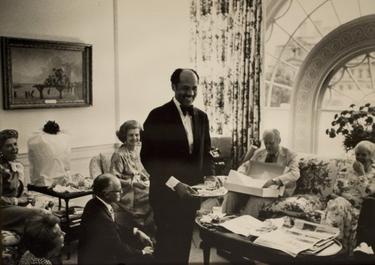 Their initial meeting convinced Haygood this Eugene Allen personified the piece of history he had been looking for. As the conversation progressed, Allen invited Haygood into the basement of his quiet D.C. home. As he flicked on the light, Haygood was struck by the testimony of objects: watercolors painted for Allen by Dwight Eisenhower, a tie clip from John Kennedy and framed photographs of the butler with each American president.