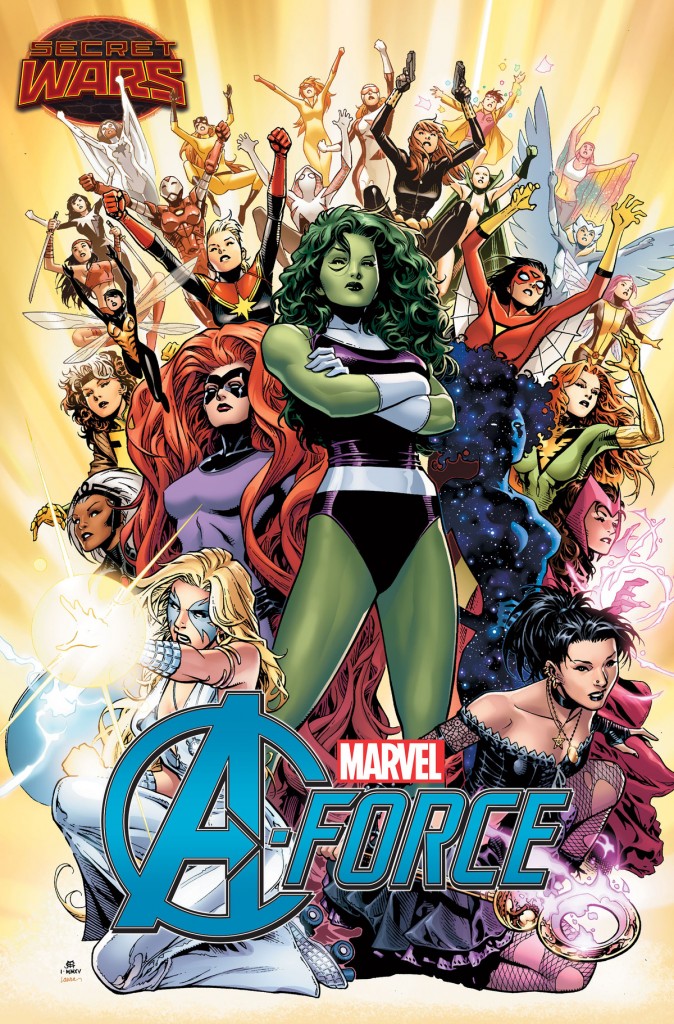
Did Marvel get it right with A-Force, its latest contribution to the world of female superheroes? Not if you ask Jill Lepore, Harvard University history professor and author of last year’s well-reviewed The Secret History of Wonder Woman. In a recent op-ed for The New Yorker, Lepore called the Avenger-type squad “porn stars.”
“Maybe it’s not possible to create reasonable female comic-book superheroes, since their origins are so tangled up with magazines for men,” writes Lepore, who won a 2006 Anisfield-Wolf prize for New York Burning. “True, they’re not much more ridiculous than male superheroes. But they’re all ridiculous in the same way.”
G. Willow Wilson, one of the creators of A-Force, responded on her Tumblr: “I imagine Dr. Lepore and I want the same thing: better, more nuanced portrayals of women in pop culture. What I don’t understand is why someone in her position would, from her perch a thousand feet up in the ivory tower, take pot shots at those of us who are in the trenches, doing exactly that.”
Wilson is a writer for the best-selling comic Ms. Marvel, which features a Muslim teen with shape-shifting powers, and she objected to the porn-star characterization head-on: “None of them are in the sexually objectified contortions that have become standard issue in recent decades. They are, in other words, posed the way their male colleagues are typically posed. They are posed as heroes.”
The annual Anisfield-Wolf brown bag lunch series at the Cleveland Public Library takes a twist this year with a deep dive into the Anisfield-Wolf catalog.
Doctoral student Valentino Zullo of Kent State University will introduce Cleveland to Anisfield-Wolf Book Award winners, both past and present. Zullo credits his mentor, Dr. Vera J. Camden, a professor of English at Kent State University, for teaching him the importance of conversation in literature. “It is through the sharing of stories that we are able to find relief from the outside world and learn to reimagine our role within it.”
Beginning Wednesday, June 10, an in-depth discussion of each book will occur over the summer. The Anisfield-Wolf Book Award book discussions will take place at the Main Library, in the literature department on the second floor. Contact the library at 216.623.2881 for more information.
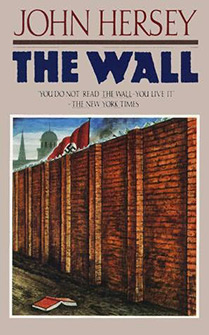
The Wall tells the inspiring story of forty men and women who escape the horror of the Warsaw ghetto from November 1939 to May 1943. Hersey, a Pulitzer Prize-winning American writer and journalist, chronicles events by means of a fictional diary kept by Noach Levinson, self-appointed archivist of Polish Jewry.
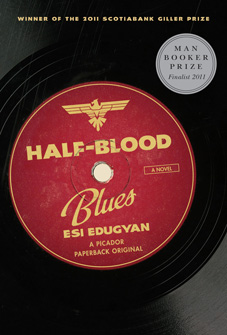
A Man Booker prize finalist, Half-Blood Blues takes the reader from 1939 to 1952, and from the smoky bars of pre-war Berlin to the salons of Paris, to discover the story of legendary jazz trumpet-player Hieronymus Falk. Declared a musical genius, he was a 20-year-old Black German citizen when he was arrested in a Paris café just before the outbreak of WWII.
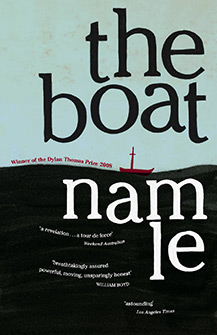
From the slums of Columbia to Iowa City to the South China Sea, Nam Le’s accomplished debut takes the reader around the world with seven stories and seven characters as diverse and imaginatively created as their locales.
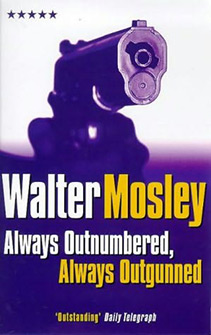
New York Times bestselling author Walter Mosley introduces a philosophical urban hero in this acclaimed collection of 14 entwined tales. Meet Socrates Fortlow, a tough ex-con seeking truth and redemption in South Central Los Angeles—and finding the miracle of survival.
Which black actors might best portray Ida Mae Gladney, George Starling and Dr. Robert Pershing Foster, the three real-life protagonists of Isabel Wilkerson’s groundbreaking history of the Great Migration, “The Warmth of Other Sons”?
A-list producer Shonda Rhimes likely has her pick of talent in the small screen adaptation of Wilkerson’s meticulous nonfiction classic, which won a National Book Award and an Anisfield-Wolf prize in 2011.
Shondaland Productions will bring “Warmth” to FX this fall, her company’s first foray into cable programming. Writer/director Dee Rees of 2011’s indie hit Pariah will write the script.
Wilkerson, a Pulitzer-Prize winning reporter, spent 15 years researching the exodus of more than six million African Americans out of the South between 1910 and 1970. If the series sticks close to its source material, viewers will come to know Gladney, who left Mississippi in 1937 for Chicago; Starling, who fled Florida in 1945 for Harlem; and Foster, who left Louisiana for Los Angeles in 1953.
More than 200 prominent authors—among them Anisfield-Wolf winners Junot Diaz and Kamila Shamsie—have publicly objected to the PEN American Center’s decision to present French satirical magazine Charlie Hebdo its Free Expression Courage award. Gunmen aggrieved by the magazine’s depiction of Islam targeted the controversial Paris weekly in January and killed a dozen people.
The signatories of an April letter to PEN argue that power and privilege must be considered when defining courageousness in satire: “The inequities between the person holding the pen and the subject fixed on paper by that pen cannot, and must not, be ignored.” One of the critics is former PEN American president Francine Prose.
Defending the decision, her successor, Andrew Solomon, co-wrote an op-ed for the New York Times, noting that, “Satire is often vulnerable to being construed as hate.” Solomon, who won a 2013 Anisfield-Wolf prize in nonfiction for “Far From the Tree,” expressed respect for those criticizing the award, but argues their emphasis is misplaced.
“I think that if we don’t endorse people who are taking these courageous stances,” Solomon told NPR, “if we don’t recognize the enormous personal risks they’re taking and if we don’t fully acknowledge that in taking that risk they keep a public discourse alive that otherwise is in danger of being entirely closed down, that we miss the purpose of standing up for free speech.”
Charlie Hebdo editor Gérard Biard is expected to accept the award on behalf of the magazine at PEN America’s annual gala in Manhattan May 5.
“I want to hear you say there should be peaceful protests, not violent protests, in the tradition of Martin Luther King,” CNN’s Wolf Blitzer lectured community activist Deray McKesson in a now infamous four-minute interview.
“You are suggesting that broken windows are worse than broken spines,” McKesson answered, contrasting property damage with the injuries that killed Freddie Gray in Baltimore police custody.
“The world is larger and more politicized than the regular American literary scene,” observed Chen, executive director of the New-York-based Asian American Writers Workshop. His wry understatement served as coda to a powerful panel that attracted more than 120 listeners at the annual Association of Writers & Writing Programs conference.
Begun in 1991, AAWW describes itself as “a safe community space and an anti-racist counterculture, incubating new ideas and interpretations of what it means to be both an American and a global citizen.”
Chen, whose book “Juvenilia” won the prestigious Yale Young Poets competition in 2009, opened the conversation with a nod to a 2012 volume that has been important to him: Pankaj Mishra’s “From the Ruins of Empire: The Intellectuals who Remade Asia,” described by the author as “part historical essay and part intellectual biography.”
With this reference, Chen tilted his audience toward a way of thinking that might be coalitional and anti-imperialist, and might see a broad range of peoples—including Persian, Pacific Islander, Indian, Japanese and Chinese—”as a kind of political identity rather than a physical or biological identity.”
Panelist Hayan Charara, a born-in-Detroit son of Lebanese immigrants, described his poetry as 20 percent political and 80 percent deeply personal. And yet, he is identified as a political poet, with such work as “Animals” and “Gaza” coming up first in Google searches. A recipient of a NEA grant in 2009, Charara is a professor at the University of Houston.
“One of the hardest tasks for an Arab to accomplish is to live non-politically,” Charara said in Minneapolis. He wrote: “The poems I submitted to the National Endowment for the Arts grew out of an enormous sense of helplessness over the ways my government—and the governments it supports—used and misused language toward violent ends. As a result, my grandfather died a victim of war, as did many family friends, old neighbors, and some animals. So while this award is especially meaningful, its irony is not lost on me.”
Oberlin College professor Kazim Ali described himself as “a yoga teacher and occasional poet who is interested in the body itself as a political instrument.” He spoke of leading eight-hour long yoga sessions over 10 days in Ramallah, Palestine, and training men from Arab villages “hungry for these yoga poses.” Although they ranged in age from 19-26, they were stiff, physically damaged by war, with “the bodies of 50-year-olds,” Ali said.
“It gave me a chance to work body by body,” he said. “It felt like a kind of physical activism.” It left Ali thinking about living without the ability to sleep, or move, constrained in a permanent disenfranchisement.
The poet Jennifer Kwon Dobbs also spoke of her body in physical space. The St. Olaf College professor was born in South Korea, taken from her mother and adopted into a white family in rural Oklahoma. This experience meant “cleaving away from place and memory, of one’s own body being deracinated—adopted—into a white family.”
After a 13-year search, the poet was reunited with her Korean family and now advocates for the rights of unwed mothers and international adoptees. Her life, she said, has been one seeking “to demand a place on the ground, and to have that ground inside your mouth, if that makes sense. I think of territory as being inside my mouth. I am learning Korean.”
The visual artist, dancer, and poet Mong-Lan talked about her family of seven, which fled Saigon when she was a girl on the last day of its evacuation in 1975. Her parents met in medical school and her father, a surgeon for the South Vietnamese Army, was dogged by post-traumatic stress. They eventually settled in Texas.
“In Vietnam, it’s called the American War,” said Mong-Lan, who returned as a Fulbright scholar in 2002 and again in 2007 to give a series of lectures at Vietnamese universities. “PTSD affects everyone in our family, including my brother’s children. It’s passed on for generations through the physical body.”
Mong-Lan, who now lives in Buenos Aires, echoed Ali, suggesting some of the answer might lie in movement itself. For writers from war-torn regions, “trauma gets relocated to another site: and that site is often the body,” Chen said.
Back side of the AAWP postcard, featuring “Stuff we happen to be into”
The cable network renowned for ambitious storytelling has optioned the rights to Marlon James’latest novel, winner of the Anisfield-Wolf Book Award this year in fiction. The book paints a complex portrait of Jamaica, hinged on the1976 assassination attempt on reggae legend Bob Marley and told in more than 30 distinct narrative voices.
James will adopt the script along with Eric Roth, who won an Academy Award in 1994 for the screenplay of “Forrest Gump.” No premiere date has been released.
James, an English professor at Macalester College in St. Paul, Minn., will take a yearlong sabbatical to concentrate on the adaptation. He told the Minneapolis Star-Tribune that transitioning his work to the small screen represents an opportunity for more character exposition.
“There are some characters in the book who are minor who I’d love to dig into in a bigger way,” he said. “And I know that Jamaica may be wary that the main character, Josey Wales, is a gangster, a bad man. But you can look to New Jersey to see how they deal with ‘The Sopranos.’ They don’t take pride in the criminality, but they look at the show and say, this [setting] is a place of deep, meaningful stories.”
by Maria Pineda
For centuries, Christians have stereotyped Muslims and I, for most of my 17 years, have stereotyped them too, especially after 9/11. I am a senior of Saint Martin De Porres High School and I grew up with Islamophobia, fear of people who practice Islam. But this year I was assigned a capstone project that I focused on Muslim life in America, because I was curious about this group that frightened me. I had believed some of the most heinous stereotypes: that Muslim men beat their wives and that all Muslims were dangerous. To me, the headscarves worn by some Islamic women looked suspicious.
A year of research upended my attitudes about Islam. Now, I am offended when someone speaks ignorantly about it. During a recent Spanish class, my teacher went over some history of Spain, noting that Muslims controlled the territory we now call Spain from 771 to 1130, and were part of a religiously mixed culture on the Iberian Peninsula for centuries. But my teacher also stated that Muslims worship Muhammad, which irritated me because I knew Muslims worship only Allah, and Muhammad is their prophet. I immediately raised my hand and told my teacher what I knew was right. To his credit, he acknowledged his mistake. I found that setting the record straight was as important to me as it would have been had my own faith been mischaracterized.
As part of my research, I interviewed Julia Shearson, a Muslim convert and executive director of the Cleveland chapter of Council on American-Islamic Relations. She taught me a good deal about Islam, carefully explaining the meaning of Jihad, Sharia Law, and the purpose of the head scarf that some Muslim women wear. Shearson confided that people sometimes fear her when they glimpse her headscarf. A stranger once jumped away from her as she exited an elevator. That left me speechless—I have rarely met a nicer person, but such incidents show how deep our stereotypes can be.
I have become a passionate ally of the religion and I intend to continue to defend it. When a newscaster reporting on ISIS refers to its members as “Jihadists,” I get angry—Jihad refers to the deep struggle of life. I had the same reaction when I heard about people in Nashville protesting against the construction of a mosque, assuming its members would plot against America and try to substitute Sharia Law for the U.S. Constitution. Discrimination like this is so offensive to all law-abiding followers of Islam.
Now I know many American Muslims struggle in our country to find a job or housing. Women who wear scarves to respect their modesty have lost opportunities and faced prejudice because of their faith. This is such an unnecessary sacrifice in 2015.
I am grateful to have researched the stereotyping of Muslims in America, and in my own mind. I hope to contribute to a cycle of enlightenment and liberation so the misconceptions and discrimination against Muslims will diminish over my lifetime, along with other prejudices in our communities.
Maria Pineda is a senior at Saint Martin de Porres High School.
At 84, Toni Morrison is full of reflection on her successes and incidents where she might request a do-over.
“It’s not profound regret,” she told NPR’s Terry Gross. “It’s just a wiping up of tiny little messes that you didn’t recognize as mess when they were going on.”
Morrison’s press tour for her eleventh novel, God Help the Child, has been full of little fascinating admissions like this. (My favorite parts of the recent lengthy New York Times profile are the quick revelations that Morrison has never once worn jeans and that she considers sleeping on ironed sheets one of life’s greatest luxuries.)
Her vulnerability is heightened during the NPR interview as she riffs on the pains and shifts that accompany older adulthood. As she has aged, her circle has become smaller; as a result, “there is this boredom or the absence of something to do.”
But the conversations all lead back to her novel, a haunting tale of childhood traumas sans redress. Bride, the main character in God Help the Child, is a dark-skinned cosmetics executive struggling with the weight of rejection that has plagued her entire life. In her review for Newsday, Anisfield-Wolf manager Karen Long calls the novel “hypnotic” and praises Morrison for her vivid language and pacing: “Morrison has a Shakespearean sense of tragedy, and that gift imbues “God Help the Child.”
In a warm lecture hall, University of Kentucky professor Adam Banks bounced and spoke with the cool cadence of a spoken-word poet, dropping gems on technology, funk and black freedom.
Born and raised in Cleveland, Banks returned to the city to argue that Stevie Wonder’s 1972 album, “Talking Book,” is a master key to black rhetoric, literacy, innovation and contemporary engagements with technology. As he stood on the campus of Case Western Reserve University, blocks from the John Hay High School he attended as a teen, Banks seemed keenly aware of geography and beginnings as he performed his presentation: “Talking Back to the Book: Critical Digital Literacies in African American Rhetorical Traditions.”
He called Wonder’s work “a funk sermon,” an infusion of new technologies, innovation and cultural pride. Funk music, he insisted, gives African Americans a framework for assessing our identities. “The boldness, the wildness, the stank of funk forces us to remember the full range of who we be, and often, forces the rest of the society to confront more of that range, that rage, that joy, that pain, that pleasure of who we be.”
Bridging the gap between the civil rights era and the black power era, “Talking Book” came out at a time when “black communities all over the country were refiguring their relationship with the United States,” Banks said.
Linking Wonder and other masters of funk to today’s rhetorical spaces, Banks described Facebook and Instagram as places where creativity and free dialogue can flourish, as it did among musicians in a studio. “That’s an example of a free space,” he observed. “It can’t be policed.”
Such places contrast with the “incessant testing, punitive mind-set and folk funding the de-funding of public education” that bedevil American schools today. And those free spaces, existing outside traditional academic environments, can be created and expanded almost anywhere. For years, Banks has hosted “community cyphers” in bars and church basements, giving lessons on blogging and social media so participants could develop a voice on their own terms. Whether using Twitter to support the #BlackLivesMatter movement or simply retweeting humorous memes, these acts link to black oral traditions such as hush harbors and “signifying.”
“There’s a relationship between innovation and tradition,” Banks insisted. “Just because there’s a lot of wild stuff happening right now, doesn’t mean it just grew. It comes from somewhere….that’s a wonderful assurance. Even if I don’t understand some things that are happening, that’s always a way in.”
The Cleveland Foundation today announced the winners of its 80th Annual Anisfield-Wolf Book Awards. The 2015 recipients of the only national juried prize for literature that confronts racism and examines diversity are:
• Jericho Brown, The New Testament, Poetry
• Marilyn Chin, Hard Love Province, Poetry
• David Brion Davis, Lifetime Achievement
•Richard S. Dunn,A Tale of Two Plantations: Slave Life and Labor in Jamaica and Virginia, Nonfiction
• Marlon James, A Brief History of Seven Killings, Fiction
“The new Anisfield-Wolf winners heighten our perceptions on race and diversity,” said Henry Louis Gates, Jr., who chairs the jury. “This year, we honor ground-breaking research into the lives of specific families enslaved on two New World plantations, a tour-de-force fictional portrayal of Jamaica spun in multiple voices, poetry from both coasts that is erotic and grave, and the indispensable, morally towering scholarship of David Brion Davis.”
Gates directs the Hutchins Center for African and African-American Research at Harvard University, where he is also the Alphonse Fletcher University Professor. He praised David Brion Davis as a foundational scholar whose Problem of Slavery trilogy is an essential work on the cultural, political and intellectual history of Western slavery and abolition. Joining Gates in selecting the winners each year are poet Rita Dove, novelist Joyce Carol Oates, psychologist Steven Pinker and historian Simon Schama.
Cleveland Foundation President and Chief Executive Officer Ronn Richard said the breadth of topics taken up by this year’s winners is gratifying, and reflects founder and donor Edith Anisfield Wolf’s belief in the power of the written word to elevate and enlighten.
“The Anisfield-Wolf Book Awards rose from the philanthropic vision of one woman who realized that literature could advance our thinking and beliefs about race, culture, ethnicity, and our shared humanity,” Richard said. “We are proud to showcase books that are beautifully written and enhance the urgent, national – and local – conversations around race and cultural difference.”
Past winners include four writers who went on to win Nobel prizes – Nadine Gordimer, the Rev. Martin Luther King, Jr., Toni Morrison and Wole Soyinka.
Meet Our 2015 Winners
Jericho Brown, The New Testament, Poetry
In the language of the blues and the Bible, poet Jericho Brown crafts 40 poems for The New Testament, a meditation on race, masculinity and gay sexuality. Anisfield Wolf juror Rita Dove calls this book “a reminder that outrage is a seductive disease — we would rather rage or weep than find a way to love in spite of the pain. Brown’s poems brim with love for this damaged world without letting the world off the hook.” And poet Rae Armantrout adds her praise, noting: “Like the other new testament, it’s about what love can do.” Brown teaches creative writing at Emory University in Atlanta.
Marilyn Chin, Hard Love Province, Poetry
Hard Love Province is the fourth collection of poetry from Marilyn Chin, whose book mourns the loss of a beloved in a world that seems inured to suffering. “In these sad and beautiful poems, a withering portrayal of our global ‘society’ emerges – from Buddha to Allah, Mongols to Bethesda boys, Humvee to war horse, Dachau to West Darfu, Irrawaddy River to San Diego,” observes Dove. Among the 23 poems are One Child Has Brown Eyes and Black President. Adrienne Rich described Chin’s work as “powerful, uncompromised and unerring.” Born in Hong Kong, Chin is a professor at San Diego State University.
Marlon James, A Brief History of Seven Killings, Fiction
In scalding yet musical language, A Brief History of Seven Killings hinges on the true 1976 attempt to assassinate reggae legend Bob Marley. Novelist Marlon James just calls him The Singer, and sets this character among a pinwheel of voices: CIA agents, child gangsters, a Rolling Stone reporter, drug dealers, corrupt politicians and a woman seriously diverted by one night with the musician. Anisfield-Wolf juror Joyce Carol Oates praised the “superb risk-taking” of James, whose story brims with profanity, violence, dialect, tenderness and cruelty. James teaches at Macalester College in St. Paul, Minnesota.
Richard S. Dunn, A Tale of Two Plantations: Slave Life and Labor in Jamaica and Virginia, Nonfiction
More than 40 years in the making, A Tale of Two Plantations is a scrupulous, revelatory archival investigation of some 2,000 people enslaved across three generations: roughly half on a Jamaican sugar plantation called Mesopotamia, and half on Mount Airy, a Virginia tidewater plantation growing tobacco and grain. Richard S. Dunn, a University of Pennsylvania historian, uses his findings to ask about enslaved motherhood, the effects of interracial sex on the meaning of family and how individuals fared upon emancipation. Oates calls the book magisterial, noting, “It is refreshing to encounter a historian who doesn’t include a forced conclusion.”
David Brion Davis is a preeminent American historian whose 1967 book, The Problem of Slavery in Western Culture, earned an Anisfield-Wolf Book Award and a Pulitzer Prize. It anchors a groundbreaking trilogy that culminated last year in The Problem of Slavery in the Age of Emancipation, which in March won the National Book Critics Circle award. Harvard University President Drew Gilpin writes that Davis’ influence is deep, having changed “traditional approaches to intellectual history by embedding ideas in social and political action and institutions.” Born in Denver in 1927, Davis is an Army veteran who retired from Yale University in 2001. He lives in Connecticut.
Anisfield-Wolf SAGES Fellow Lisa Nielson had the honor of introducing Chang-Rae Lee to the packed audience at the 2015 Writers Center Stage series, sponsored by the Cuyahoga County Public Library and Case Western Reserve University. Her remarks, reprinted here, remind us why these conversations—about strong books and the authors that birth them—matter.
by Lisa Nielson
Cleveland has a long history of celebrating literature and the arts. As many of you know, we are the home of the Anisfield-Wolf Book Awards, now about to celebrate her 80th year, which is one of the most important and inspiring book awards in the country. They were started by Cleveland philanthropist and poet Edith Anisfield Wolf in 1935 to honor books focused on what was then called “race relations.” Today, the list reflects an awe-inspiring array of thinking and scholarship on human diversity, including ground-breaking studies on slavery in the US, racism and genocide, neurodiversity and disability, immigrant experiences and global diasporas.
Each September, I ride downtown with my students on the Healthline to attend the awards ceremony. Sharing the evening with them is one of the highpoints of my year. My students have a great time and are also unanimous that the food is excellent. I mention this because this year we have had the pleasure of having two past winners of the Anisfield-Wolf Book awards grace our campus: Zadie Smith last September and this evening, Dr. Chang-rae Lee.
Doing justice to Dr. Lee’s amazing career in a few minutes is impossible, so I’ll mention just some of his many accomplishments. He was born in Seoul, Korea, and moved with his family to the US as a young child. After receiving his BA in English from Yale, Dr. Lee found a job working as an equities analyst, but continued to write. He went on to earn an MFA in creative writing from the University of Oregon, where he was later hired as an assistant professor. He then ran and taught in the MFA program at Hunter College in NYC. Since 2002, Dr. Lee has been a Professor of Creative Writing at Princeton University. Dr. Lee has written five, highly-acclaimed novels, as well as short stories and articles for the New Yorker, New York Times, Granta, and many other prominent publications in the US and abroad.
His first novel, Native Speaker (1995) won the Hemingway Foundation/PEN Award for Best First Novel, the American Book Award, the Barnes & Noble Discover Award, and an ALA Notable Book of the Year Award. In 1999, the New Yorker listed him as one of the 20 best American writers under 40. His second novel, A Gesture Life (1999), won the Anisfield-Wolf Book Award for fiction in 2000, and The Surrendered (2010) was a finalist for the Pulitzer Prize in 2011. Dr. Lee’s most recent novel, On Such a Full Sea, published in 2014, was a finalist for the National Book Critic Circle Award for Fiction.
To me, reading his work is a full sensorial immersion. His writing is gorgeous, elegant, sensuous, and often funny. Dr. Lee’s novels address fundamental questions about the nature and composition of identity and cultural assimilation. Yet, his definitions of identity are not limited to ethnicity, gender, language, social class, or other academic categories, but how these aspects of our selves intersect with each other, the choices we make and our communities. He defies genre labels by writing in different vernaculars and slipping into the skins of men and women of all ages and backgrounds. Using the canvas of recent history, such as the Korean War, the abuses of comfort women by the Japanese during WWII, the experiences and assimilation of new Americans, Dr. Lee invites the reader into what Gloria Anzaldua called the borderlands; breaking us out of our hyphenated binaries and assumptions that identity is forever fixed.
In each novel, Lee places us – sometimes gently, sometimes not – on the path of a journey-in-progress. We are tossed into the deep end of life where we bump up against those swimmers we encounter as we move from one body of experience to the next. While on the way, we realize that although our complex human identities may include important components such as ethnicity, gender, or privilege, it is our relationship to others that gives meaning and definition to our ever-changing selves. This odyssey is perhaps most fully realized in Dr. Lee’s most recent novel, On Such a Full Sea, which is a futuristic imagining of the world following environmental disaster. In it, we follow the journey of Fan, who is part of a colony of workers originally transported from Asia to grow vegetables and fish in what is now called “B-Mor”, the former Baltimore, for the wealthy elites of the Charters. She is a skilled diver who immerses herself in the rough world as she seeks her lost lover, Reg, who has been stolen because he is C(ancer)-free. The fact of her journey causes her home community to rebel against the carefully padded limitations they have been surrounded by, and she fundamentally changes the people who encounter her.
Through Fan, Henry Park of Native Speaker, Doc Hata in A Gesture Life, Hector and June in The Surrendered, we are reminded that all of us swim together, immersed in the world; and that the ripples we cause as we move forward lap unavoidably against those of the people we encounter along the way. When we dive deep, we find we are all capable of changing and being changed.
Lisa Nielson is the Anisfield-Wolf SAGES Fellow at Case Western Reserve University. She has a PhD in historical musicology, with a specialization in Women’s Studies, and teaches seminars on the harem, slavery and courtesans.
by Sarah Marcus
Like many of my days spent teaching, today feels hard, but important. By 10 a.m. I’ve already had some awesome, small victories. A student ran upstairs 10 minutes before class to make sure that he understood what the word “vixen” meant and wanted to discuss if he could use it in a feminist context within his “Be A Man” poem. He told me that this felt like the biggest and most important question that he had all year. He caught the bus early so that he could be at school early to talk to me about it.
The “Be A Man/Woman” poem assignment originated from a powerful in-class discussion that we had about gender and masculinity. In my 12th Grade Creative Writing Class, largely due to the influence and materials of one of my incredible mentors, Daniel Gray Kontar, we have recently been examining Feminism and Hip-Hop. We are learning to identify poetic and literary devices through the analysis of classical poets and Hip-Hop poets. We are looking at the larger conversation that occurs in R&B music amongst emcees. We looked at ’80s and ’90s hip-hop feminists and we are now looking at and discussing the feminism and anti-feminism of Nicki Minaj. We are talking about objectification and authoring our own identities. We are talking about the double standards and negative connotations that come with women “acting like men” and vice versa. We began this unit by watching the documentary film MissRepresentation in order to provide context about how gender is portrayed in the media.
During one of our discussions about gender expectations and slut shaming, one of my senior girls says, “A master key is a key that can open any lock. That’s how we treat boys having sex. But, a lock that can be opened by any key is a bad lock. That’s how people look at girls.” Brilliant. Devastating.
We watch an interview with Nicki Minaj where she talks about how a man is a boss and a woman is a bitch when they try and get things done. We want to know what it means to be a successful businessman/woman. Some of my students have deeply held and extremely traditional beliefs about gender roles. We talk about how that is OK, if that’s what both people in a relationship want. We talk about how feminism means that you get to choose. We talk about consent.
My students, for the most part, are pretty invested. They are also super insightful. They are becoming educated consumers. I get emails and texts at all hours of the day and night with video clips or pictures that involve pop-culture that addresses feminist themes. As a teacher, this fills my heart with joy.
One day, we began a class with a short video from the #VogueEmpower Campaign to #StartWithTheBoys called “Boys Don’t Cry.”
During our follow up discussion, one of my girls says, “I would want my husband to tell my son to stop crying. I don’t want no sissy son. My daddy hit my mom because his daddy hit his mom. Not because someone told him not to cry or to stop acting like a girl.” I think being a good teacher means that everyone feels safe in your classroom, even when comments make your stomach turn. Everyone’s voice must be respected and valued. Everyone comes from different experiences. To model this care is what allows students to explore and challenge each other in a moderated space. So, I try to respond with the love and tolerance that I desperately want them to show each other. I say, “That’s a really interesting point. It makes sense to me that the act of simply telling a boy not to cry doesn’t necessarily make him into an abuser. Do you think that was the message in this video?”
We talk about life cycles. About what happens when we are not allowed to have or express emotion? What happens when we are punished for our emotions? How many people have ever bottled up their emotions and then it all came out at once in an angry explosion, raise your hand? All hands go up. I relate, too.
One student is deeply is offended by the video. “I would never do that,” he says, “That’s not fair.” I give them a brief history of #NotAllMen and then I give a race analogy. What does it mean to say, I wouldn’t say racist things, so the problem of racism doesn’t apply to me? What is our responsibility as humans? As advocates? What does it mean to say that you don’t see race, or that in your personal experience, that’s not how racism works? What is the danger in that narrow perspective? How does it perpetuate racism? Rape culture? We begin to scratch the surface of intersectionality.
We spend another class talking about whether there is such a thing as a “real” man or a “real” woman. Is “real” just our way of separating out how some people use their actions, beliefs, and attitudes to help others and some people use them to hurt others?
Everyone wants to be black; everyone doesn’t want to be black. People want to be black when it benefits them. They try and show so much pride in them when we get a black president. They don’t want to show up for the million man march the next day. It’s not a choice to be black, it’s your life. You have to choose. To you what does that mean? Are you the thug on the street with a gun at your side dealing drugs or are you in school getting your education?
Another student responds: “Things I’m tired of hearing as a black man and from other black men: You got any felonies, you got kids, can you rap, you play basketball right, you getting them new J’s, nigga, spare change, who is you, you’re not my dad, f- the police, he talk white…”
I love these kids. I really love them. I don’t need them to think like me, but I do need them to feel challenged to think deeply. They challenge me, too. Most of my students still want to know when I’m going to stop “holding [his abusive actions] over Chris Brown’s head, because he’s apologized like a million times, Ms. Marcus!”
One of my students aptly points out that if you are conditioned to have no emotion, if you are programmed that way, it isn’t possible to believe that other people have emotions. It’s not possible in this scenario to have empathy, because you feel nothing.
I talk about the importance of empathy and being sensitive and expressing emotion… how I personally believe that expressing emotion and the ability to be sensitive and empathetic is healthy and helps us act loving and tolerant towards one another. I say that true strength comes with showing people care and forgiveness.
The boy sitting next to me says emphatically, “But, Ms. Marcus! Isn’t your boyfriend a bodybuilder!?”
And I say, “Yes, he is! This is an excellent point.” I talk about the stereotypes I had in my head about what I thought it meant to be bodybuilder before we met. I told them about the assumptions that I made about how I thought that my partner must have defined masculinity based on my assessment of his social media pages. I told them that I almost didn’t give him a chance. How I thought he was a hyper-masculine “bro.” After all, how smart could you be if you cared so much about muscles? Bodybuilders (in my mind) were self-absorbed, obsessed chauvinists with a one-track mind. Unfair? Extremely. I thought that he had a whole lot of dudes drinking out of red cups in his pictures… He had a lot of memes about #squatting and #fitgirls… oy vey, I thought. No thanks.
But, throughout our correspondences he was smart and witty and thoughtful and attentive. He read all of my online articles and was able to make intelligent comments about them. My partner, like many men I’ve met in their late 20s, didn’t identify as a feminist (despite being one) until he met me. Today, he is an incredible and visible ally and advocate. I tell my students that he is the kindest, most compassionate, sensitive, chivalrous and emotionally advanced man I have ever met, and we get to talk about how a man can be all of those things. I tell my partner about our class discussion and he writes a beautiful, thoughtful response to the kids about what masculinity means to him. This is how “Be A Man/Be A Woman” poems happened. I knew we needed to creatively process these discussions.
In regards to this morning, another one of my senior boys wrote a truly powerful poem about masculinity and orchestrated opportunities for audience participation. He even came to me after school last week to discuss my partner’s response to what it means to “be a man.” We went paragraph by paragraph. He was so interested in how someone could identify as both a very “masculine” bodybuilder and also as a feminist. This is a student who turns in no work and is constantly on the verge of being kicked out. I wrote a positive letter home, and when I went to put it in his file, I saw a long list of notes home about failing classes. This was his first positive home contact and he has been here for four years. Another one of my male (cis) seniors wrote a poem from the perspective of a young gay man. Kind of groundbreaking, right?
I was so invigorated by these wins. These dedicated and brave students. Then, I open my email from our school social worker to read that another one of my freshmen girls lost a family member to a fatal drive-by shooting. These types of emails are not uncommon. Recently, another one of my senior boys lost four family members in a brutal home murder. Sometimes it feels like you are doing so much, and then you realize that you are doing so little. These kids live in a reality riddled with violence that most of us can’t possibly begin to understand. I learn from their strength and fortitude. I try to grow from it. I am humbled and blessed to be able to do this job. So, when I feel like I’m having a tough day because my body hurts due to a slew of not fun health issues, I think about how my day isn’t actually tough at all. It’s all about my perspective and attitude. It’s never going to be as hard for me as it is for them. That’s why I teach. Because everyone deserves a chance. These kids, especially. I want them to have the tools to change the narrative. They are brave and they are empowered to author their own identities. Our actions matter. Teachers matter. Students matter. I want them to have a voice, to know their voice, and to use their voice.
Sarah Marcus is the author of BACKCOUNTRY (2013, Finishing Line Press) and Every Bird, To You (2013, Crisis Chronicles Press). Her other work has appeared or is forthcoming in McSweeney’s, Cimarron Review, CALYX Journal, Spork, Nashville Review, Slipstream, Tidal Basin Review, and Bodega, among others. She is an editor at Gazing Grain Press and a spirited Count Coordinator for VIDA: Women in Literary Arts. She holds an MFA in poetry from George Mason University and currently teaches and writes in Cleveland, OH.
Bryan Stevenson needs no notes.
Not for his TED Talk, not for his Daily Show appearance, and not for his 40 minutes on stage in Cleveland.
Some 800 people made reservations to hear him—so many that his host, Facing History and Ourselves, moved the event to a larger auditorium at Cleveland State University. As Stevenson entered, the assembly was on its feet, prompting Felton Thomas, executive director of the Cleveland Public Library, to raise his eyebrows: “A standing ovation before he even speaks?”
The bald, soft-spoken lawyer—who wore the same suit and tie as he did for Jon Stewart—promised “we can create greater justice in Cleveland” and offered four organizing principles to accomplish this. But he began with bad news: “We are in a very, very different place in this country than we were 40 years ago, a more discouraging place. In 1972, 300,000 people were behind bars; the prison population is 3.2 million now with six million on probation. There are 68 million Americans with criminal arrests.”
One in three black boys born today is expected to go to jail—a blistering rate of incarceration unseen in the 19th or 20th centuries. In Alabama, where Stevenson has spent 30 years fighting the death penalty and overseeing the Equal Justice Institute in Montgomery, 34 percent of the black male population has permanently lost the right to vote.
“If we are to create more justice, we have to reposition ourselves,” Stevenson said. “We must get closer to the places—the schools, the city neighborhoods, the jails—where there is injustice. Distance will create bad outcomes.” This lesson arrives on page 14 of Stevenson’s 2014 memoir, “Just Mercy,” and comes from his formidable grandmother, whose own parents were enslaved in Caroline County, Virginia.
This bit resonated particularly for Mark Swain-Fox, executive director of the Cleveland offices of Facing History: “I haven’t read a book in the last decade that had the same impact on me.”
Smiling slightly and often, the author mined many of the book’s anecdotes, collapsed into a presentation that both inspired and challenged. Before he finished law school, Stevenson interviewed a shackled, death-row inmate, and the encounter altered his life’s course. “Proximity,” he said, “has this way of waking up things in you that you didn’t know were asleep.”
The second proviso is to change the racial narrative in our heads. Stevenson called on his listeners to see that the story that labeled children—mostly black and brown boys—as super-predators led to unjust sentences and horrific outcomes. “The narrative has to change about race,” he said. “We have been contaminated, all of us, by the silence that surrounds racial inequality.”
Because there was no equivalent to South Africa’s Truth and Reconciliation Commission for the United States, America has slipped from slavery to lynching and terrorism to Jim Crow to mass incarceration without confronting the legacy. “The great evil of slavery wasn’t involuntary servitude,” Stevenson said, “it was the notion of white supremacy.”
Stevenson, 55, said his parents were humiliated every day of their lives by this falsehood. The collective, happy sense that civil rights got accomplished in three metaphorical days—Rosa Parks sat down, the Rev. Martin Luther King Jr. marched, and voting rights laws passed— ignores the lived experience of black folk, and the mass incarceration of today.
The third prong of creating more social justice, Stevenson said, is protecting one’s hopefulness. He told a story of seeing an Alabama truck festooned with Confederate flags and a bumper sticker that read “If I’d have known it would be like this, I would have picked my own cotton.”
The truck belonged to a prison guard who harassed and strip-searched Stevenson before he could visit a client. The law professor felt hopeless when he returned and spotted the same truck in the prison parking lot. But the hostile guard had sat in the back of the courtroom during Stevenson’s oral arguments defending a cognitively diminished man, and, because of his own experiences in foster care, saw the situation differently. The man greeted Stevenson, asked to shake his hand, and admitted having gone out of his way to bring the impaired prisoner a milkshake.
The fourth, and most difficult requirement, is finding the courage to make oneself uncomfortable. “Why do we want to kill all the broken people?” Stevenson asked, listing those broken by poverty, racism, neglect, despair and disability. He said he has come to understand himself as broken, and to embrace those most reviled in society as his community.
Stevenson said he understood being the victim of serious crime; his own grandfather was killed when Stevenson was 16. But he wants more than retribution. He wants what Portugal has started, a wholesale route to rehabilitation for addicts. And a legal system that doesn’t assume—as the Chicago judge did when he mistook Stevenson as a defendant—that black is criminal and dangerous.
Famed dancer and choreographer Judith Jamison warned a recent audience that she has a tendency to ramble: “I will be reading my remarks. Otherwise I’ll be totally scattered. It’s kind of like when I dance.”
Over 40 minutes at Baldwin Wallace University near Cleveland, Jamison still strayed, but her colorful asides drew an intimate portrait of 50 years with the storied Alvin Ailey American Dance Company. Elegant in a sleek black shirt and pants, covered with a multicolored shawl, she sauntered from point to point, at ease in front of a near-capacity crowd.
Jamison, 71, joined the company in 1965 at the request of Alvin Ailey himself, who founded the dance troupe out of frustration over the lack of opportunity for black dancers. She marveled at Ailey’s physicality: “He moved his whole body like liquid. No one moved like him.” She danced and choreographed with him for more than 20 years, then became artistic director after Ailey’s 1989 death. She stayed until 2011 and remains on the board as artistic director emerita.
Born in Philadelphia on the precipice of the Civil Rights movement, Jamison told her audience that she was drawn to Ailey because of the way he saw the arts as fundamental in the struggle for equality.
“When Dr. King said, ‘We must not allow our creative protest to degenerate into physical violence…Again and again we must rise to the majestic heights of meeting physical force with soul force,’ our soul force was our performance,” Jamison said. “And our dancing was our protest. Alvin Ailey wanted a company that would explore the black cultural experience. He wanted to show our beauty, our dignity, our passion using the powerful language of dance theater.”
Her life was defined by those lessons of race and dignity, she said, beginning as a six-year-old student of pioneering dance instructor Marion Cuyjet. As an African-American woman with green eyes, light skin and red hair, Cuyjet used her ability to “pass” to teach young black children who would otherwise be barred from formal instruction.
Cuyjet, Jamison said, was evicted from seven studios, but the teacher never let institutional racism stop her. Watching her instructor repeatedly shift facilities taught Jamison an important lesson: “You have to make your own door when the door won’t open. Make your own frame and walk through the door you created.”
Jamison’s parents nurtured her artistry and encouraged both their children to savor life. “We didn’t have a whole lot of money, but they made things accessible,” she said. “The root of my artistic and cultural life comes from being taken to operas, concerts, theater, and from hearing my father’s calloused fingers play a Rachmaninoff sonata.”
The pioneering dancer’s tone warmed as she shared her desire to spread the power of the arts to youth in the same ways her parents did—by exposing them early and watching them find their doorways. “I enjoy seeing young people entering the theater as individuals, and leaving as part of a community,” she said, beaming wide. “That’s how the arts are supposed to make you feel.”
“They’re going to throw me in director’s jail,” director Ava DuVernay remembered thinking before premiering “Selma” at the American Film Institute in November. Sweating buckets in the bathroom before the screening, she was so stressed she recalled devising a back-up plan if the film bombed: “Maybe Ben [my agent] can help me get another $200,000. I’ve still got stories. I was freaking out.”
It was one of the delightfully transparent anecdotes DuVernay shared during her one-hour keynote at South by Southwest, one of the country’s biggest tech and culture conferences, held every March in Austin, Texas. Equal parts laidback and constructive, her talk veered from screening her film at the White House for the First Family, her strategy for staying rooted while filming “Selma,” and her biggest realization after the Oscars. A few highlights:
1. She felt she was chasing the wrong things while making her first two films.
“On I Will Follow, I was proving my worth through distribution and the box office…My worth was outside of myself. On Middle of Nowhere, I was proving my worth through festivals and accolades. My worth was outside of myself. I was just going from thing to thing, accomplishment to accomplishment and my heart wasn’t enlarging…The dreams were too small. If your dreams only include you, they’re too small.”
2. She doesn’t shy away from a challenge.
“You can tell any story for any amount of money. That’s why it was important for me to not go from a $20 million film to another film but to completely change gears.” 2015 will see her at the helm of two TV projects—a civil rights procedural for CBS as well as a series adaptation of Natalie Baszile’s novel Queen Sugar for the Oprah Winfrey Network. In both, she said her goal is to “slip in some stories about marginalized folks that aren’t usually on the forefront.”
3. Her daily “gratitude list” keeps her grounded.
DuVernay said Oprah encouraged her to write down five things that she is grateful for every day. The practice came in handy during the film’s controversy over the portrayal of President Lyndon B. Johnson. “I thought, what am I grateful for today? Well…I’m in the New York Times.”
4. Her mission is consistent from project to project.
“The image is vital. So if there’s a dearth of them, it affects the way we see ourselves and the way that we are seen…Stop asking people who don’t care about the work and just do the work. If I look at television and I think something’s missing, then you have to go do the work. A lot of people talk and I try to act.”
HBO will turn Ari Shavit’s My Promised Land into a television documentary, CEO and chairman Richard Pleper announced at the 2015 INTV media conference in Jerusalem.
“The book left me awestruck and as moved as I’ve been maybe ever,” Pleper told the crowd. “When I first approached him, I said to Ari that I’ve waited my whole adult life to find this book.”
Published in 2014, “My Promised Land” is a carefully crafted narrative history, weaving family memoir, documents and hundreds of interviews with Arabs and Jews. The book, Shavit’s first, took home the 2014 Anisfield-Wolf Book Award for fiction.
No release date has been set, but Israeli filmmaker Dan Setton, whose previous work has centered on Israeli-Palestinian conflict, has been tapped to direct.
Poet Rita Dove introduced Toni Morrison—the only living American Nobel recipient in literature—with joy and grace and poetry at the New School in Manhattan, where Morrison received the National Book Critics Circle’s Ivan Sandrof award—its lifetime achievement prize. The NBCC stressed that Morrison the editor, the essayist, the critic, the mentor and professor had made enormous contributions to American letters, in addition to her luminous books. But it was the eloquent Dove, a Pulitzer winner, a former U.S. poet laureate and long-serving juror of the Anisfield-Wolf Book Awards, who made a case for the ages. Dove remembered herself as a searching young woman, the only African American graduate student at the University of Iowa’s Writer’s Workshop:
“One day, deep in the bowels of the library, I stopped dead in my tracks. Something had caught my eye; I wasn’t sure what. There, just behind my left shoulder . . . I couldn’t shake the feeling a book was looking for me. Since it was spring, when such things happen, I didn’t question the feeling, I just turned around. And there it was, at eye-level, bound in black linen and peacock-blue lettering: THE BLUEST EYE by Toni Morrison.”
This first novel, which transformed Dove, met a different initial critical reception, one Morrison remembered as “slight, indifferent, even hostile” until the critic John Leonard took up the novel and wrote about it.
Last Thursday night, when a resplendent Morrison, 84, rolled onto the stage in her wheelchair and wearing a gray beret, a standing ovation enveloped her. She looked at Dove, smiled and cracked wise: “Rita, that was beautiful. And true.”
Read the entire Dove introduction, reprinted with permission, here:
Good evening. Thank you, Steven Kellman and the Board of the National Book Critics Circle, for inviting me to introduce Toni Morrison as the recipient of this year’s Ivan Sandrof Lifetime Achievement Award. Although Toni Morrison certainly doesn’t need an introduction per se, there can scarcely be too many celebratory tributes to one of the greatest novelists of our time and the only living American Nobel laureate in literature. I don’t have to rattle off Toni Morrison’s many accomplishments and honors to those present here tonight. As book critics you are, by and large, deeply familiar with her works, and your organization was among the very first to publicly recognize the rising star when, in 1977, she received the National Book Critics Circle Award for “Song of Solomon.”
In our age of factual information cascading from smart phones at the tap of a few buttons, you don’t need me to refresh your memory with all the titles of our honoree’s eleven luminous – and illuminating – novels and her numerous other works – the plays and essays and children’s books. I also assume you wouldn’t want me to whittle away minutes at this podium with a recitation of previous awards… although, I admit, it is tempting to mention at least a few – such as the 1988 Pulitzer Prize for “Beloved,” the 1996 Jefferson Lecture, the National Humanities Medal in 2000, the honorary doctorate from Oxford and the 2012 Presidential Medal of Freedom.
Although my personal panoply of greats—that literary Valhalla I call upon for inspiration—is heavily weighted in favor of the craft of poetry, Toni Morrison has always commanded a prime seat front and center, for she is not only a prose virtuoso but also a master of poetic sensibilities and lyrical language: Her influence on discourse, idiom and the vernacular has transformed our perception of the intricate paths to the interior consciousness – be it the thoughts of an illiterate slave or the harrowing logic fabricated by a father guilty of incest; of children whose souls have been damaged beyond the reach of pity and women ravaged by a longing so desperate that nothing short of annihilation will satisfy; of a ghost starved for love, of a town bent on its own brand of self-preservation. With an extraordinary poet’s economy of idiom and her signature elliptical elegance, Toni Morrison has probed the crannies and tunnels of mental illness and the torment of war veterans shattered by the myriad possibilities for sabotage in the world; she has recreated the improvisational call-and-response of jazz, the see-saw proclivities of obsessive attraction and violence freighted with fear. And while birthing upon the literary stage a host of characters we, the readers, recognize as familiar and accept in the way of Family, from the praiseworthy to the quirky to the closeted, she has also been – subtly, cannily – at work on fashioning a new graph of American history whose many intersecting trajectories take us from the Anglo-Dutch slave trade through the ante-bellum insanities of Southern racial terror, from the Great Migration and 1920’s Harlem to the labor pains of the Automobile Age whose factories disgorged a glittering stream of chrome-trimmed fantasies from what are now the rust belt cities of the Midwest; from the L.A. cosmetics industry to a trailer parked outside of Whiskey, California.
A few days after I received Steven Kellman’s call asking me if I’d like to pay homage to Toni Morrison tonight – an undertaking somewhat tantamount to introducing Athena, while she looks on with her gray eyes – my husband and I went to a dance – a milonga – at our local Argentine tango club. In an attempt to boost everyone’s mood in the middle of a drear, chilly winter and as a nod to the Carneval season, everyone was asked to come masked. But when we arrived with our Venetian facial wear and harlequin confections, we quickly discovered that the masks got in the way of dancing – ribbons tangled, feathers snagged on gold braid trim, and with obstructed peripheral vision, balance was impaired so we teetered and wobbled. After a quick confab with the young man who had asked me for the second set of tangos – a newcomer to our town – we decided to ditch the masks; and as the bandoneon throbbed to Carlos Gardel singing about the kind of woman who can ignite an “instant violent love”, my dance partner remarked, out of the blue: “Now that’s some Toni Morrison love.” I was struck with speechless. But by the next day my curiosity had overwhelmed my hesitancy, so I asked this young man, via a Facebook message, what his first encounter with the books of Toni Morrison had been. His response was effusive and – there’s no other way to describe it – grateful. He wrote:
I think I was 22 or 23—after college but before grad school. I went into a bookstore and had a sort of literary crisis. I felt that so many of the authors on the shelves were creating entire worlds and entire castes of characters that merely served as backdrops for the breakdown of yet another petty “I.” Like all those books could be retitled “The Day *I* Was Sad.” Then I picked up “Beloved.” Faith in literature restored. What a genius Morrison is! I think so many novelists are like peacocks with their language, flourishing feathers and letting the reader know how smart and lyrical they are. But I think Morrison is able to do extreme lyric and yet be conversational at the same time. I wish I had found her work earlier. I want to know why she isn’t required reading in school. Morrison has wisdom in abundance, along with lyrical and storytelling brilliance. I wonder how she does it.
And my tango-dancing friend ended with a postscriptum prompted by his wife of just a few months:
Now my wife wants to tell you about how she battled the Dominican obsession with Aryan features as a teenager but then encountered “The Bluest Eye” in high school. She says Morrison gave voice to all of her dissent and made her comfortable with it.
Four decades earlier I had fought a similar battle with myself and the strange environment I had chosen to immerse myself in when I attended the University of Iowa’s Writers Workshop as its only African-American graduate student. As a young poet still trying to locate myself in the thicket of literary traditions, I often wandered the stacks, willing myself into unknown territory. I had yet to find myself, or at least an image I could identify with, in the pages of European and American literature; while most of the books concerned with Black America took place, by and large, either in the Deep South or in urban ghettos. What about the experiences and dreams of a black girl growing up middle class in middle America? I wondered. Was there no room, no mirror, for me? Then one day, deep in the bowels of the library, I stopped dead in my tracks. Something had caught my eye; I wasn’t sure what. There, just behind my left shoulder . . . I couldn’t shake the feeling that a book was looking for me. Since it was spring, when such things happen, I didn’t question the feeling; I simply turned around. And there it was, at eye-level, bound in black linen with peacock-blue lettering: THE BLUEST EYE, by Toni Morrison.
The library had removed all book jackets, so there was no biographical note, no blurb to give me a hint of the contents. The title intrigued me; I didn’t know the author, but as soon as I opened the book and began to read, I was convinced that Toni Morrison, whoever she was, knew me, my people and where I came from – Akron, Ohio, one of the industrial towns sprinkled along the smudged neckline of the Great Lakes. By the time I finished the opening section – those three amazing paragraphs mimicking the eerie deadpan of primary school primers, variations on an American Dream gone horribly wrong – I was certain that this writer had also experienced, as I had, the “double-consciousness” which W.E.B. Du Bois defines as that “peculiar sensation … of always looking at one’s self through the eyes of others, of measuring one’s soul by the tape of a world that looks on in amused contempt and pity.” When I reached the sentence, “Not even the gardens fronting the lake showed marigolds that year,” a wild hope began to stir that maybe, just maybe, she was from the Midwest. Fifteen pages later came the confirmation I craved: “There is an abandoned store on the southeast corner of Broadway and Thirty-fifth Street in Lorain, Ohio.” I began to shiver. My gut response had been right: Toni Morrison was a home girl.
No words can fully express what Toni Morrison has meant to me ever since – as a writer, a woman, a black woman, and, yes, a fellow Ohioan. She gave me literary shelter and pointed me toward the poetry in my geographical space. She taught me to pay attention to everything without prejudice, for beauty can be found in the “ginger sugar” smell rising from a polluted lake, and the fate of an empire can rest on the curve of an eyebrow. Her work has accompanied me through my years of honing myself as a writer and a woman. How desolate that journey would have been without Milkman and First Corinthians, or Flores or the intrepid Sula; without Toni’s wry humor and chastening gaze, her laughter that seems to come straight up from the middle of the earth!
Over the years Toni and I have met a number of times – official events as well as more private gatherings; even once by chance, late one evening in a hotel lobby in Cleveland where we convinced the bartender to serve one more round of drinks before closing shop. But two scenes with Toni stand out vividly – a 1994 tribute in her honor at the Cathedral of St. John the Divine, and a gala seven years later at the New York Public Library in celebration of her 70th birthday. In both places Toni was surrounded by orchids. Orchids – those gorgeous, engorged blooms that come in every color you can think up (and beyond), their petals veined like human hands held to the light, with a smell as intimate and ravishing as an indelicate thought crossing your mind in the middle of the 23rd psalm. As symbols of love and desire (both the light and the dark sides), they can make young girls blush and coax a Mona Lisa smile from a grown woman; these curiously mammalian creatures that seem to live on nothing but mist and air, yet can inspire in their breeders a devotion teetering on madness. Orchids are the queen bees of the flower world, and you better not mess with them.
Like the orchids surrounding her then, Toni Morrison has always seemed both rooted in the earth and poised for flight, resplendent and serene. Most importantly, she has woven tales that beguile, even as they lead us deeper into the carefully shielded psyche of homo sapiens than we knew to go. She has given us stories where survival may not mean victory and cruelty may reveal itself as the ultimate tenderness; stories where home is not a country, especially when the country has never learned to be at home with its past – and from the midst of those magnificent specimens of art, Toni Morrison – woman, mother, editor, writer, critic, Nobel laureate, professor, mentor, friend – shines all the more fiercely. I thank you, Toni, for your life’s work past, present and future, and for your resplendent example. May you keep on shining.
Just who is an American Indian?
For hundreds of years, this riddle of identity has vexed the federal government and the tribes alike, writes Marcos Barbery, an investigative reporter and documentary filmmaker. He and his co-director, Samuel Z. Russell, worked for four years to craft a concise 64-minute movie to explore it.
“By Blood,” sponsored by the Anisfield-Wolf Book Awards at the 2015 Cleveland International Film Festival, takes up a contentious case moving through the federal courts now: Descendants of slaves once owned by the Cherokee and Seminole nations, made members of the tribe by treaty at the conclusion of the U.S. Civil War, are fighting to continue to be counted as Indians. And leaders of the tribes are opposing them, having disenfranchised some 30,000 people.
“The Freedmen descendants are waiting for a decision right now,” Barbery said in a telephone interview. “The issue is ongoing—we were filming in February and we have a new cut. There were protests three weeks ago in Oklahoma City.”
The consequences have economic, racial, and cultural ramifications. If the African Americans lose, the matter could well go before the U.S. Supreme Court, Barbery said. “This is a conflict between tribal sovereignty and the 13th Amendment (which abolished slavery). These are two traditionally oppressed communities battling it out.”
Asked about the tone of “By Blood,” Barbery said, “It’s anything but a downer. It’s a journey through this world—Indian County—populated by an enormous number of African Americans. It has all kinds of twists and turns and there are moments of humor.”
Both directors, both 34, will be present to answer questions at the Cleveland screenings: 9 p.m. Thursday, March 26 and 12:10 p.m. Friday, March 27. Tickets are $13 for film festival members, seniors and students; $15 for others.
Moviegoers can receive a $2 discount at the box office, online or ordering on the phone, by using the Anisfield-Wolf Book Awards code: ANWO.
 Did Marvel get it right with A-Force, its latest contribution to the world of female superheroes? Not if you ask Jill Lepore, Harvard University history professor and author of last year’s well-reviewed The Secret History of Wonder Woman. In a recent op-ed for The New Yorker, Lepore called the Avenger-type squad “porn stars.”
 The Wall by John Hersey