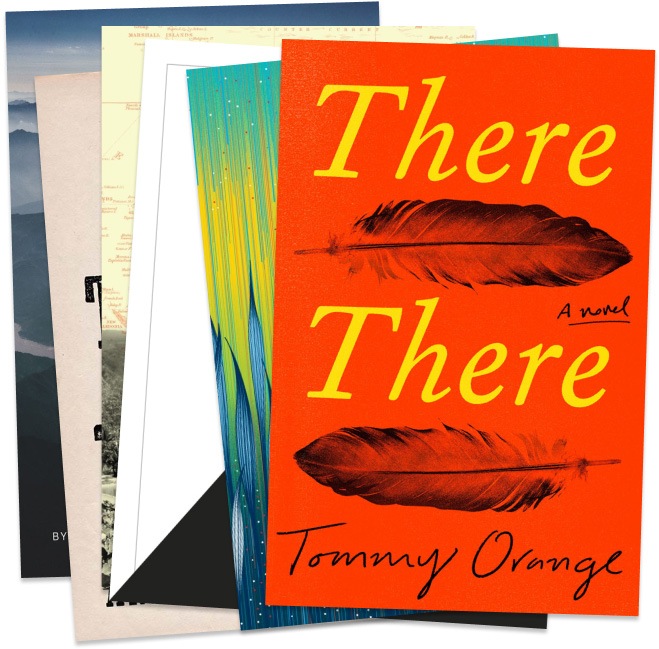
Are you looking for the perfect gift for the readers on your list? Look no further! We have compiled a list of some of our favorite Anisfield-Wolf Book Awards winning titles for every reader, from fiction fans to history lovers, there is something in the AWBA canon for everyone!
The New-to-AWBA Explorer
People who want an approachable starting place—accessible reads that open the door to the canon.
Memorial Drive by Natasha Trethewey (AWBA Nonfiction 2021):
In this sublime memoir, our Anisfield-Wolf Book Awards jury chair reckons with the murder of her mother at the hands of her stepfather. The poetic prose will grip you as Trethewey masterfully revisits the deeply segregated South, miscegenation laws, and the life she built in the wake of trauma.
Feeding Ghosts by Tessa Hulls (AWBA Memoir 2025):
As the first graphic novel to win an Anisfield-Wolf Book Award, this text is perfect for the reader who values a visual story. Former AWBA winner and current AWBA juror Peter Ho Davies writes, “Tessa Hulls’ graphic memoir, Feeding Ghosts, is a compendious multi-generational epic combining a sweeping history of twentieth century China with an intimate, extraordinary family story. Feeding Ghosts crosses oceans, continents and decades to make whole a family, restore a home and as readers we are privileged to join a journey told in such richly expressive images and vivid prose.”
The Warmth of Other Suns by Isabel Wilkerson (AWBA Nonfiction 2011):
Through narrative storytelling, Wilkerson writes a definitive account of the Great Migration—a period in history when six million Black citizens migrated from the South to the North and the West in search of greater opportunity. Wilkerson’s masterwork sheds light on a six-decade period of “unrecognized immigration” within the United States, documenting a legacy of citizens who left home to follow their dreams.
The Binge Reader
The one who says, “just one more chapter,” stays up way too late, and always needs another great read queued up.
Colored Television by Danzy Senna (AWBA Fiction 2025):
This satirical novel follows Jane Gibson, a middle-aged writer whose latest book project “her mulatto War and Peace” never makes it to market and puts her tenure-track into question. Desperately seeking economic stability for her family, she descends into the underbelly of Hollywood. This page-turning text is full of Jane’s questionable decisions, unexpected plot twists, and Senna’s brilliant commentary on race and class in a post-post-racial America.
Deacon King Kong by James McBride (AWBA Fiction 2021):
If an elderly deacon marching out of a housing project in South Brooklyn and shooting the most ruthless drug dealer in the first paragraph doesn’t get you to binge read this novel, I’m not sure what will. McBride weaves humor and gripping prose to create a portrait of a working-class neighborhood grappling with poverty, compassion, and faith.
The Association of Small Bombs by Karan Mahajan (AWBA Fiction 2017):
Mahajan’s second novel starts with Chapter 0—the detonation of a bomb in the Lajpat Nagar market in New Delhi. This explosive beginning is followed by a riveting account of the aftershocks of a terrorist attack. Written in third person, Mahajan writes with psychological empathy for both the victims and the perpetrators, complicating our understanding of violence and sympathy. Read this before his third novel comes out in March 2026.
The Social Justice Seeker
Looks for literature that illuminates injustice, elevates marginalized voices, and inspires action.
“A Problem From Hell”: America and the Age of Genocide by Samantha Power (AWBA Nonfiction 2003):
In this groundbreaking text now over 20 years old, Power analyzed U.S. foreign policy in the 20th century to explain the repeated failure to act in the face of genocide. Documenting the U.S.’ position in Cambodia, Iraq, Bosnia, Rwanda, Kosovo and beyond, Power’s text questions pragmatism in the face of atrocity. The perfect choice for a social justice seeker grappling with contemporary questions around genocide, U.S involvement, foreign policy, and morality.
Bunk: The Rise of Hoaxes, Humbug, Plagiarists, Phonies, Post-Facts, and Fake News by Kevin Young (AWBA Nonfiction 2018):
“Bunk is an essential book. It unpacks myriad hoaxes embedded in American history, from Spiritualism to the fake news espoused by Donald Trump. As Kevin Young explores these hoaxes, he finds that there is darkness at the heart of our country, a malignant seed, that finds expression in fakery. Young writes with humor and wit, and during this moment when alternative facts are sanctioned and willful ignorance is celebrated, this is a necessary read.” – Jesmyn Ward on Bunk
Deaf Republic by Ilya Kaminsky (AWBA Poetry 2020):
Kaminsky’s second poetry collection is set in an occupied territory during a time of political unrest. In the first poem of Act One, a solider shoots and kills a young deaf boy and it renders the entire town deaf. This 76-page urgent elegy lifts a mirror up to our collective silences in the face of atrocity and forces us to face what it means to live
in a peaceful country.
The Gay Revolution: The Story of the Struggle by Lillian Faderman (AWBA Nonfiction 2016):
Faderman’s archival research and 150+ first-person interviews resulted in her 2016 landmark text—The Gay Revolution. Starting from the 1950s when the law classified gays, lesbians, and trans people as criminals and working her way up to the fight for marriage equality under Obama’s presidency, Faderman documents the gay-rights movement. As the ACLU tracks 616 anti-LGBTQ bills in the United States as of September 2025, revisiting this text and filling in the ten-year gap between the time of its publication might be critical to understanding where we came from and where we’re heading in the fight for gay rights.
The Global Traveler
For readers who love literature that transports them across cultures, borders, and identities.
Aké: The Years of Childhood by Wole Soyinka (AWBA Nonfiction 1983):
In 1986, Wole Soyinka was awarded the Nobel Prize for Literature making him the first African laureate. Three years prior, the first installment of his memoir, Aké, won the Anisfield-Wolf Book Award for nonfiction. Here, Soyinka documents his childhood living in a Yoruba village in western Nigeria from ages 4-11. Pick up this text for a chance to experience pre-World Word II Nigeria from a curious and always-questioning child-eye’s view.
The Old Drift by Namwali Serpell (AWBA Fiction 2020):
Serpell’s debut novel, which took nearly two decades to craft, centers on a fateful 1904 incident near the Old Drift, a colonial settlement on the Zambezi River just a few miles from Victoria Falls. In the aftermath of this tragic incident, Serpell follows three generations as they collide over the course of a century. Former Anisfield-Wolf Book Awards juror Rita Dove writes, “The Old Drift” is “a phenomenal accomplishment, nothing less than a retelling/reimagining of the creation and ‘history’ of Zambia. The writing is exquisite; her descriptions of water – Victoria Falls, Lake Malawi, even rain – are awesome.”
The Boat by Nam Le (AWBA Fiction 2009):
If you’re looking for a single book to take you around the world, look no further than The Boat by Nam Le. Le’s debut is a collection of seven different short stories set in Colombia, Japan, Iran, Australia and the United States. Spanning different points of view and different time periods, think of each short story as a trip to a new place. On each stop you’ll meet new characters, each faced with an urgent threshold they must cross over.
The Archivist
Drawn to narratives—fiction or nonfiction—that uncover untold truths, cultural histories, or lived experience.
The US Governed by Six Hundred Thousand Despots: A True Story of Slavery by Jonathan D. S. Schroeder (AWBA Nonfiction 2025):
In this groundbreaking text, Schroeder uncovered the 1855 first-person slave narrative written by John Swanson Jacobs—brother of Harriet Jacobs—in an Australian newspaper. Reproduced in full, this narrative, written by an ex-slave and ex-American, inserts a new 19th century global slave narrative. In the second half of the book, Schroeder writes a full biography on Jacobs’ life, adding context by an esteemed literary historian.
Hidden Figures by Margot Lee Shetterly (AWBA Nonfiction 2017):
Shetterly’s debut novel tells the story of four black women mathematicians working at NASA beginning in 1948. Their calculations during the Space Race era allowed the country to successfully send astronauts into orbit, to the moon and back. “The title of the book is something of a misnomer,” Shetterly writes in her acknowledgements. “The history that has come together in these pages wasn’t so much hidden as unseen—fragments patiently biding their time in footnotes and family anecdotes and musty folders.”
Horse by Geraldine Brooks (AWBA Fiction 2023):
Horse is for the historical fiction fans. When Brooks’ learned that the Smithsonian had recently received a donation of the skeleton remains of the 19th century thoroughbred horse Lexington, she was intrigued. She would go on to uncover the critical role Black horseman played in building the thoroughbred industry. This novel is the story of that legendary Pre-Civil War racehorse, Lexington, and his Black groomer, Jarret. Not only does Brooks paint a picture of race relations at the cusp of national division, she brings the legacy of enslavement into the modern day with a contemporary storyline that makes you question just how far we’ve come.